
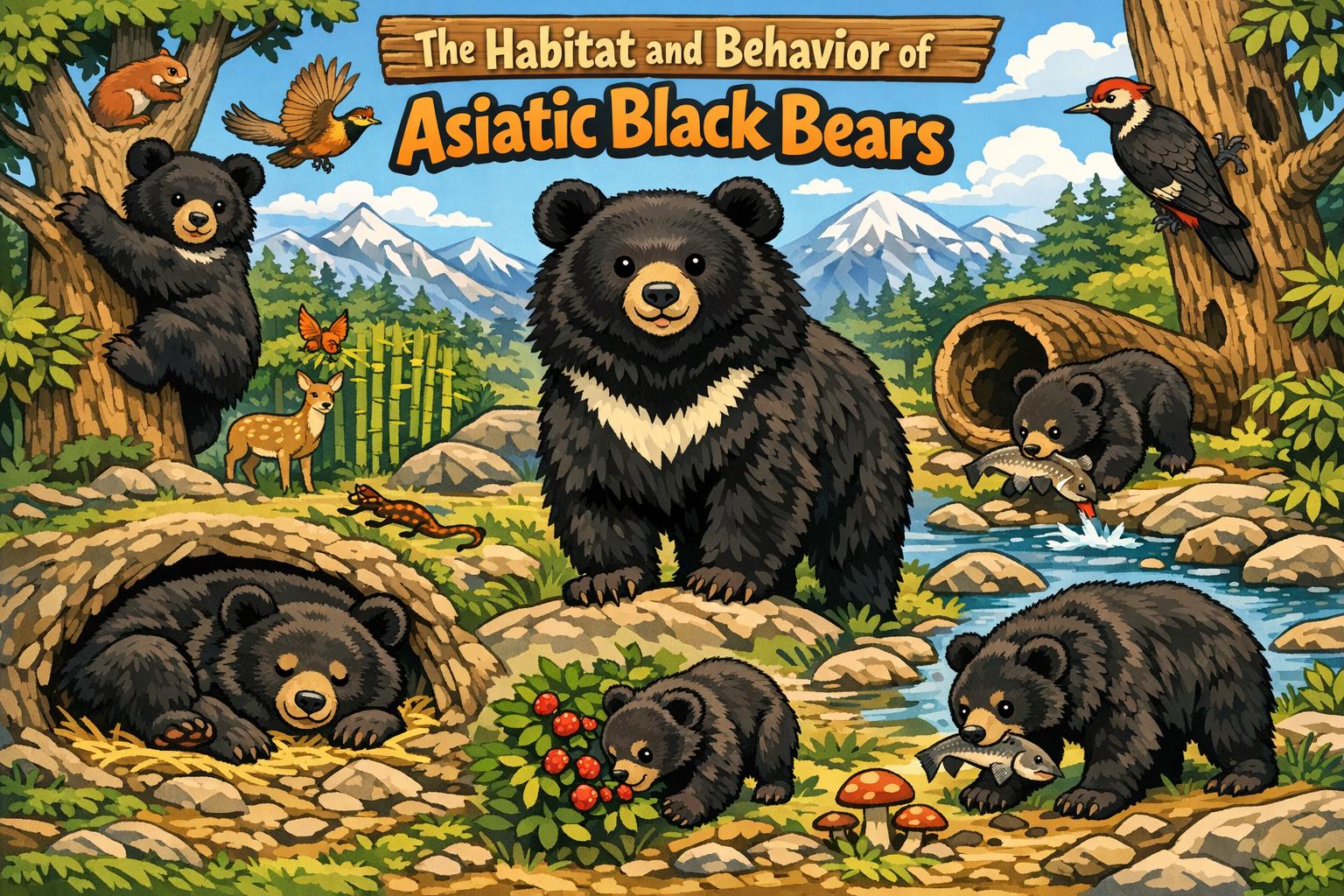
The Asiatic black bear (Ursus thibetanus), also known as the moon bear because of the crescent-shaped white marking on its chest, is one of the most widely distributed bear species in Asia. Its range spans from the mountains of western Iran across the Himalayas and into East Asia, including parts of China, Korea, Japan, and the Russian Far East. Throughout this broad distribution, the species occupies a wide range of habitats and demonstrates flexible behavior shaped by climate, terrain, food availability, and human pressure.
Although the Asiatic black bear shares ancestry and several traits with the American black bear, it has adapted to markedly different ecosystems. Its ecology reflects a mix of arboreal skill, seasonal movement, and dietary versatility. Understanding the habitat requirements and behavior of this species is essential for conservation planning, particularly as habitat fragmentation and human encroachment increase throughout much of Asia.
Geographic Distribution and Range
The Asiatic black bear has one of the largest distributions of any bear species in the world. Historically, its range extended uninterrupted from western Asia to the Pacific coast. Today, its populations are fragmented but still widespread. Significant populations occur in northeastern China, the Russian Far East, the Korean Peninsula, Japan’s Honshu and Shikoku islands, and along the Himalayan belt including Nepal, Bhutan, and northern India.
In parts of Southeast Asia, including Vietnam and Laos, populations persist in forested mountain regions. Western populations in Iran and Pakistan are more isolated and vulnerable. The International Union for Conservation of Nature (IUCN) lists the species as Vulnerable. Updated distribution and conservation information can be found at the IUCN Red List.
Habitat Preferences
The Asiatic black bear primarily inhabits forested mountainous regions. It shows a preference for broadleaf and mixed forests, especially those containing oak species that produce acorns, a key seasonal food source. In the Russian Far East and northeastern China, it also occupies temperate deciduous and mixed conifer forests. In the Himalayas, it can be found in subtropical forests at lower elevations and temperate forests higher up.
Altitude use varies by latitude. In tropical and subtropical regions, bears often remain at higher elevations year-round where temperatures are cooler. In temperate regions, seasonal altitudinal migration is common. During spring and summer, they may move to higher elevations to exploit emerging vegetation, while in autumn they descend to lower forests rich in mast-producing trees.
The species demonstrates an ability to use fragmented habitat, but requires sufficient forest cover for feeding, denning, and escape from disturbance. Dense understory vegetation and large trees are particularly important. Unlike some other bear species, Asiatic black bears spend a considerable amount of time in trees. Forest structure therefore directly influences habitat quality.
Home Range and Spatial Behavior
Home range size depends on food availability, sex, and habitat productivity. Adult males typically occupy larger ranges than females, sometimes exceeding 100 square kilometers in low-productivity areas. Females with cubs maintain smaller ranges centered around reliable food sources and secure den sites.
Home ranges of adult males may overlap with those of several females, but adult males tend to avoid each other outside of the breeding season. Spatial organization is flexible and influenced by mast abundance. In years of abundant acorn or nut production, home ranges may temporarily contract as bears concentrate feeding efforts.
Movement patterns often follow ridgelines, forest corridors, and river valleys. In mountainous areas of Japan and the Himalayas, seasonal altitudinal shifts of several hundred meters are well documented. These movements are not true migration but opportunistic tracking of food resources.
Diet and Foraging Behavior
The Asiatic black bear is an omnivore with a highly varied diet. Plant matter constitutes the majority of its intake for most of the year. Spring diets often include young shoots, grasses, bamboo, and emerging herbs. The bears also strip bark from certain trees, feeding on cambium layers.
Summer brings fruits and berries. In many parts of its range, late summer and autumn are defined by heavy consumption of nuts, particularly acorns and chestnuts. This period of hyperphagia—intense feeding prior to winter—is critical for building fat reserves.
Although primarily herbivorous, the species readily consumes animal protein when available. This includes insects, larvae, small mammals, carrion, and occasionally ungulates. In the Russian Far East, predation on deer fawns has been recorded. Bears may also raid agricultural crops such as corn and orchards, increasing conflict with humans.
Foraging strategies often rely on climbing. Asiatic black bears are particularly agile in trees, using their strong curved claws to ascend trunks and access fruit or nuts. They may construct feeding platforms from broken branches high in the canopy, where they sit and feed for extended periods.
Denning and Hibernation
Denning behavior varies depending on climate. In northern portions of the range, such as northeastern China and Russia, Asiatic black bears enter winter dormancy for several months. In warmer southern regions, denning may be shorter or absent entirely.
Dens are typically established in tree cavities, under rock overhangs, or in hollow logs. In steep mountainous terrain, natural caves are commonly used. The choice of den site emphasizes insulation and protection from predators and disturbance.
Females give birth during winter dormancy, usually between January and February. Cubs are born blind and weigh only a few hundred grams. The mother remains in the den nursing and conserving energy until spring emergence. Litter size most commonly ranges from one to two cubs.
Reproductive Behavior
The breeding season generally occurs from June to August. Like several other bear species, the Asiatic black bear exhibits delayed implantation. After fertilization, the embryo does not immediately implant in the uterus. Implantation occurs in late autumn, ensuring that birth coincides with winter denning when the mother is sheltered.
Sexual maturity is typically reached at three to four years of age. Reproductive rates are relatively low, contributing to vulnerability under hunting or habitat pressure. Females usually reproduce every two to three years, depending on cub survival and body condition.
Mothers are attentive and defensive. Cubs remain with their mother for up to two years, during which time they learn foraging skills, climbing proficiency, and habitat use patterns. This extended dependency shapes the species’ population growth rate.
Daily Activity Patterns
Asiatic black bears are generally crepuscular, with activity peaks in early morning and late afternoon. However, activity patterns can shift significantly in response to human disturbance. In areas with high human presence, bears may become more nocturnal.
Resting sites include dense vegetation on slopes, tree platforms, or ground depressions. In hot climates, bears may seek shaded forest interiors during midday. Their thick fur provides insulation against cold but can contribute to heat stress in warm environments, reinforcing the importance of forest canopy cover.
Communication and Social Behavior
Like most bears, the Asiatic black bear is largely solitary. Exceptions include females with cubs and temporary aggregations at abundant food sources. Social structure is loosely organized, with communication occurring primarily through scent marking, vocalizations, and visual signals.
Scent marking involves clawing tree trunks and rubbing against bark, leaving both visual and olfactory cues. These marks may communicate reproductive status or territorial information. Vocalizations include huffs, growls, and roars, particularly during aggressive encounters or maternal defense.
Direct confrontations between adults are relatively rare but can occur during mating season. Body size dimorphism is moderate, with males generally larger than females. Adult weights vary widely across the range, typically between 60 and 200 kilograms, depending on region and season.
Interactions with Other Wildlife
The Asiatic black bear shares habitat with several large carnivores, including the Amur tiger in the Russian Far East. While tigers have been documented preying on bears in some regions, such interactions are uncommon and context-dependent. In most habitats, the bear occupies a mid-to-upper trophic level niche, acting as both predator and seed disperser.
By consuming fruit and dispersing seeds through scat, Asiatic black bears contribute to forest regeneration. Their digging for insects and tubers also influences soil turnover. In this way, the species plays an ecological role that extends beyond its immediate dietary habits.
Human-Bear Conflict
Throughout much of its range, the Asiatic black bear increasingly encounters human settlements. Agricultural expansion, logging, and infrastructure development have fragmented forests. Bears may raid crops or enter villages in search of food, particularly in years of poor mast production.
In parts of the Himalayas and Japan, conflicts have increased where rural depopulation has allowed forest regrowth near abandoned farms, creating edge environments attractive to bears. Management strategies include electric fencing, improved waste management, and public education campaigns.
Poaching remains a serious threat. Bears have been hunted for meat, skins, and body parts. The issue of bile extraction for traditional medicine has drawn international attention. Conservation groups such as Animals Asia work to combat illegal bile farming and promote rescue efforts.
Conservation and Habitat Protection
Effective conservation of the Asiatic black bear depends largely on maintaining connected forest habitats. Protected areas across China, Russia, and parts of the Himalayan region provide refuges, but many populations exist outside these zones. Wildlife corridors are essential to maintain gene flow between fragmented populations.
Research using GPS collars and camera traps continues to improve understanding of habitat use and movement. In Japan, long-term ecological studies have documented the relationship between mast production and bear population dynamics. Such research informs adaptive management strategies.
International cooperation is important given the species’ transboundary distribution. Agreements between Russia and China, as well as regional conservation initiatives in the Himalayas, aim to coordinate monitoring and enforcement efforts.
Conclusion
The Asiatic black bear demonstrates a combination of adaptability and ecological specialization. It thrives in diverse forest types, from subtropical Himalayan slopes to temperate mixed forests of northeastern Asia. Its behavior is shaped by seasonal food availability, forest structure, and human presence.
Primarily solitary, largely herbivorous, and strongly tied to forest ecosystems, the species depends on intact woodland habitat for survival. Arboreal skill distinguishes it from some other bear species and influences its feeding ecology and denning behavior. At the same time, low reproductive rates and increasing habitat fragmentation present ongoing challenges.
Sustained conservation efforts focused on habitat protection, conflict mitigation, and anti-poaching enforcement are necessary to ensure the long-term stability of Asiatic black bear populations. As forest landscapes continue to change across Asia, understanding the relationship between habitat and behavior remains central to preserving this distinct and widespread bear species.