
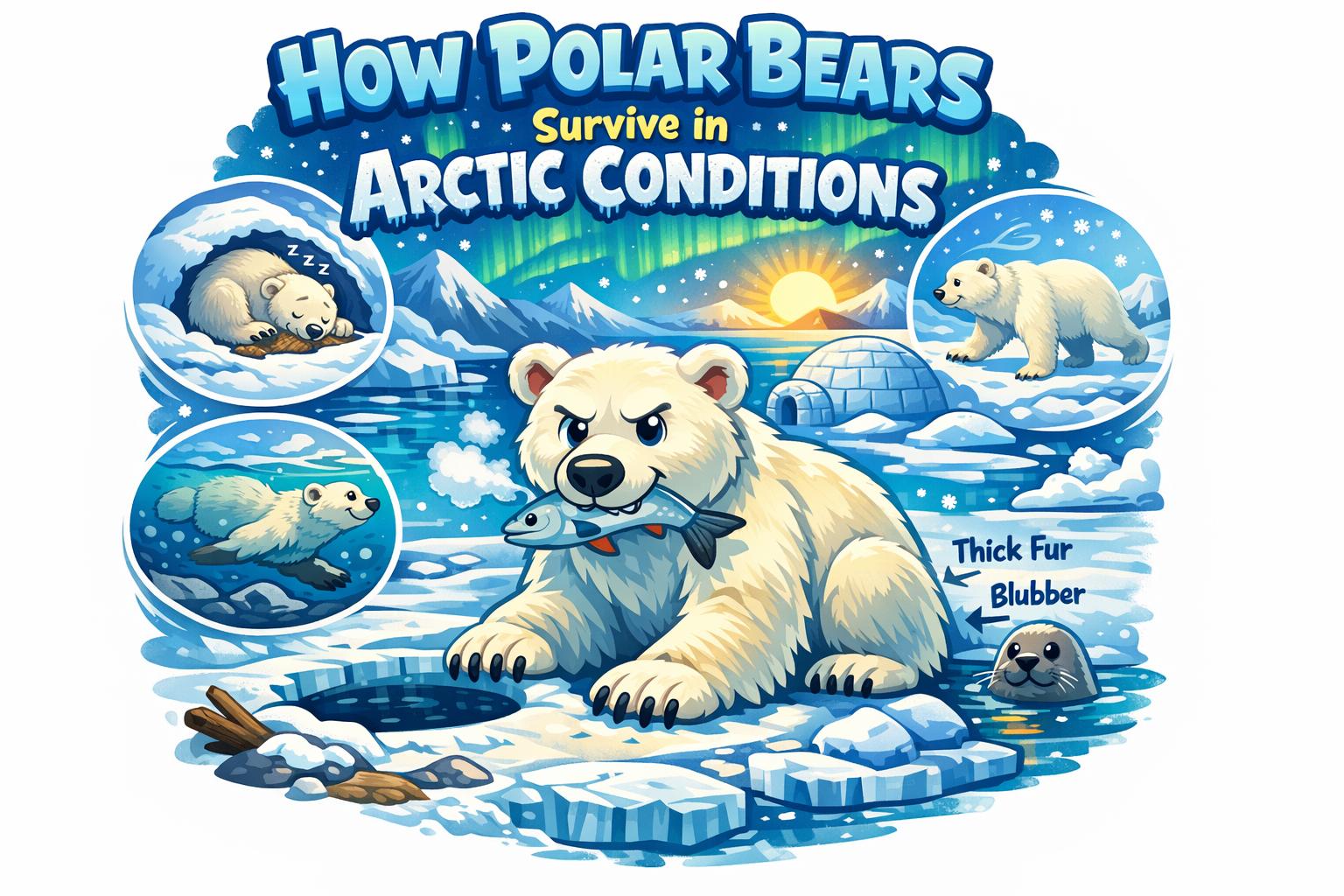
Polar bears (Ursus maritimus) live in one of the most physically demanding environments on Earth. The Arctic is defined by prolonged winter darkness, extreme cold, shifting sea ice, and seasonal food scarcity. Yet polar bears thrive there as apex predators. Their survival relies on a combination of anatomical specialization, metabolic flexibility, behavioral adaptation, and close ecological ties to sea ice. Understanding how polar bears endure Arctic conditions requires examining the interaction between their biology and the environment they inhabit.
Thermal Insulation and Body Structure
The Arctic winter routinely brings temperatures below −30°C (−22°F), with strong winds that intensify heat loss. Polar bears maintain a stable core temperature around 37°C (98.6°F) through multiple layers of insulation. The most visible layer is their dense fur, which consists of two types of hair: a thick underfur and longer guard hairs. The guard hairs are hollow, helping to trap air and improve insulation.
Beneath the fur lies a substantial layer of fat. Adult polar bears can carry up to 10–12 cm (4–5 inches) of blubber. This adipose tissue serves several functions: insulation against cold air and icy water, buoyancy while swimming, and stored energy for periods when food is unavailable. The blubber layer is especially critical during winter and early spring when hunting conditions fluctuate.
The skin of a polar bear is black. This pigmentation absorbs solar radiation, providing an incremental but meaningful heat gain during sunlit months. Although Arctic sunlight is limited in winter, continuous daylight in late spring and summer increases exposure.
Body shape also contributes to temperature regulation. Polar bears have a relatively small surface-area-to-volume ratio compared to smaller mammals, reducing heat loss. Their ears and tails are short and rounded, minimizing exposed extremities that could lose heat or suffer frostbite. These structural adaptations reflect the general biological principle known as Bergmann’s rule, where animals in colder climates tend to have more compact bodies.
Paw Adaptations for Ice and Snow
Movement across fragmented sea ice requires specialized limbs. A polar bear’s paws can measure up to 30 cm (12 inches) across. The broad surface distributes weight, functioning like snowshoes to prevent breaking through thin ice. The soles are covered with small dermal papillae—rough projections that improve traction on slippery surfaces.
Sharp, curved claws provide grip and are essential for securing prey. Unlike brown bears, polar bears rely heavily on ice stability for hunting seals. Their limb structure supports both long-distance walking and powerful bursts of speed over short distances. Despite their size, polar bears can sprint at speeds approaching 40 km/h (25 mph), though only briefly.
Metabolic Efficiency and Energy Storage
The Arctic ecosystem is highly seasonal. Polar bears may experience extended fasting periods when seals are inaccessible. To survive, they depend on a metabolism capable of handling large lipid intake and long fasting intervals.
Ringed and bearded seals constitute their primary prey. Seal blubber is calorie-dense, allowing bears to consume large quantities of fat in a single feeding event. An adult polar bear may eat over 40 kg (88 pounds) of seal tissue at once, selectively consuming fat to maximize caloric intake. This feeding strategy supports rapid accumulation of body reserves.
During lean months, polar bears reduce physical activity and rely on stored fat. Their metabolic rate decreases in ways that resemble a walking hibernation, though they do not undergo true hibernation except for pregnant females. Research summarized by the U.S. Geological Survey indicates that energy conservation is critical as sea ice seasons shorten in some regions.
Swimming Ability in Frigid Water
Polar bears are classified as marine mammals because of their dependence on ocean habitats. They are strong swimmers, capable of covering tens of kilometers in a single stretch. Documented long-distance swims exceeding 100 km (62 miles) illustrate their endurance, though such events can impose physiological stress.
Several features enable cold-water swimming. The thick blubber layer insulates against heat loss in water that may be near freezing. Large forepaws function as paddles, while hind legs act as rudders. Bears typically maintain a steady pace of around 6–10 km/h (4–6 mph) in water.
Swimming is not merely a movement strategy but a survival tool in a landscape where sea ice is constantly shifting. As ice floes drift apart, polar bears must navigate between hunting grounds. According to NOAA, changes in sea ice distribution directly influence the frequency and distance of these swims.
Sea Ice as a Hunting Platform
Sea ice is central to polar bear survival. Unlike terrestrial bears, polar bears rarely hunt on land. Instead, they use sea ice as a platform from which to capture seals that surface at breathing holes.
Still-hunting is the most common technique. A bear waits motionless beside a seal’s breathing hole for extended periods, sometimes hours. When a seal surfaces, the bear delivers a rapid strike with its forepaw and pulls the prey onto the ice.
This method requires patience and acute sensory perception. Polar bears have an exceptional sense of smell, capable of detecting seal dens beneath snow or carcasses kilometers away. Their hearing and vision, while not extraordinary compared to other bears, are well adapted for the Arctic’s open expanses.
Seasonal ice dynamics determine hunting success. In spring, when seal pups are abundant, bears accumulate most of their annual fat reserves. The IUCN Polar Bear Specialist Group provides detailed assessments of how ice timing affects body condition across subpopulations.
Behavioral Adaptations to Seasonal Extremes
The Arctic year alternates between continuous daylight and continuous darkness. Polar bears adjust their activity patterns accordingly. They do not rely strictly on diurnal cycles; instead, activity often follows prey availability and ice conditions.
In winter darkness, bears continue hunting using smell as a primary sense. During summer, when sea ice retreats in some areas, certain populations spend more time on land. There, they conserve energy by resting and limiting unnecessary movement. While they may scavenge whale carcasses or hunt birds opportunistically, terrestrial food rarely compensates for the caloric value of seals.
Denning behavior is another key adaptation. Pregnant females excavate snow dens in late autumn, typically on stable landfast ice or coastal areas. Inside these dens, they give birth to cubs weighing about 600 grams (1.3 pounds). The mother remains in the den for several months, relying entirely on stored fat while nursing. Her metabolic adjustments prevent muscle atrophy and excessive bone loss during this extended fast.
Reproductive Timing and Cub Survival
Polar bear reproduction is synchronized with environmental cycles. Mating occurs in spring, but implantation of the fertilized egg is delayed. This process, known as delayed implantation, ensures that active pregnancy proceeds only if the female has accumulated sufficient fat reserves.
Cubs emerge from dens in early spring when seal hunting improves. The mother’s milk is extremely rich in fat, sometimes exceeding 30% fat content. Rapid growth during the first months is essential, as cub mortality can be high if environmental conditions deteriorate.
The maternal investment period extends over two to three years. During this time, cubs learn hunting strategies, ice navigation, and swimming skills. This prolonged dependence increases juvenile survival in a challenging ecosystem.
Sensory and Cognitive Adaptations
Life on sea ice requires spatial memory and orientation skills. Polar bears traverse large home ranges, sometimes exceeding hundreds of thousands of square kilometers. They must remember productive hunting areas and seasonal ice patterns.
Olfaction is particularly developed. Studies indicate they can detect seals beneath 90 cm (3 feet) of snow. This capability allows them to locate subnivean birth lairs during spring.
Cognitively, polar bears show problem-solving behavior when accessing food, including manipulating ice blocks or investigating novel objects. Such flexibility is advantageous in a variable Arctic environment.
Physiological Resilience to Fasting
Extended fasting presents metabolic challenges. Polar bears can lose significant body mass over several months without food, relying on fat metabolism while conserving lean tissue. Nitrogen recycling mechanisms may reduce muscle breakdown, preserving strength for when hunting resumes.
However, fasting capacity has limits. If ice breakup occurs earlier than usual, bears may be forced ashore before building adequate fat stores. Research published through organizations such as NASA’s Earth Observatory links sea ice trends to shifts in body condition across some regions.
Interaction with the Arctic Ecosystem
Polar bears occupy the top trophic level in the Arctic marine food web. Their reliance on seals connects them to primary productivity cycles driven by plankton blooms beneath sea ice. The entire system depends on seasonal sunlight and ice formation.
Scavengers, including Arctic foxes and gulls, benefit from polar bear kills. Carcasses left on the ice transfer marine-derived nutrients to other species. In this way, polar bears indirectly shape nutrient distribution within coastal ecosystems.
Limits of Adaptation
Polar bears are highly specialized. Their evolutionary path favored efficiency in ice-based hunting rather than dietary flexibility. While they can consume berries, bird eggs, or carrion, these foods do not match the caloric density of seals.
This specialization explains both their success in historical Arctic conditions and their vulnerability to rapid environmental change. The World Wildlife Fund provides current summaries of conservation challenges linked to habitat shifts.
Conclusion
Polar bears survive in Arctic conditions through integrated adaptations spanning anatomy, physiology, and behavior. Dense fur, thick blubber, compact extremities, and specialized paws provide insulation and mobility. Metabolic efficiency allows them to convert seal blubber into long-term energy reserves. Acute olfactory senses and patient hunting strategies maximize success on shifting sea ice. Reproductive timing aligns cub development with seasonal prey abundance.
These traits collectively enable polar bears to endure cold, darkness, and food variability. Their existence illustrates how closely evolution can tailor a species to a specific ecological niche. At the same time, the tight linkage between polar bears and sea ice underscores the importance of stable Arctic conditions for their continued survival.