
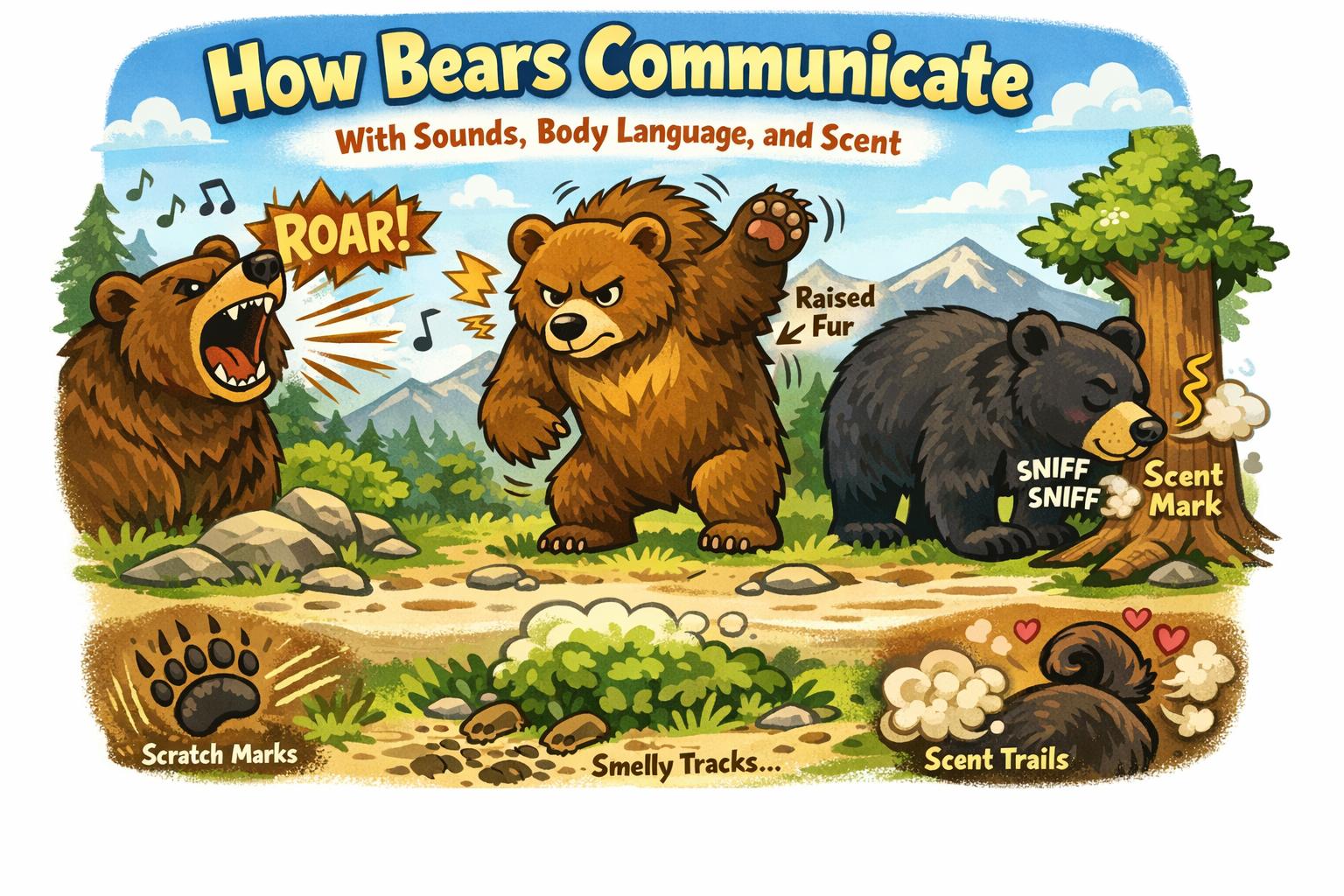
Bears rely on a combination of vocalizations, body language, and scent communication to interact with one another and to interpret their environments. Although they are often perceived as solitary, bears maintain complex communication systems that regulate breeding, territorial boundaries, maternal care, and conflict avoidance. Each sensory channel serves a distinct purpose, and together they form an integrated network of signals that function across dense forests, open tundra, and mountainous terrain.
Acoustic Communication: Sounds and Vocal Signals
All bear species produce a range of sounds, though they are generally less vocal than highly social carnivores such as wolves. Bear vocalizations are typically context-specific and often used at close range. Cubs are the most vocal age group, while adults rely more heavily on scent and posture.
Vocalizations of Cubs
Bear cubs produce repeated bawling, whining, humming, and squealing sounds to signal distress, hunger, discomfort, or separation from their mother. These calls are high-pitched and carry effectively through dense vegetation. Mothers respond rapidly to distress vocalizations, demonstrating that auditory cues play an essential role in maternal care.
Cub humming, sometimes described as a rhythmic purring sound, commonly occurs during nursing. Researchers studying American black bears (Ursus americanus) and brown bears (Ursus arctos) have recorded these sounds as indicators of contentment and contact reassurance.
Adult Bear Vocalizations
Adult bears vocalize less frequently, but their sounds convey clear intent. Common vocalizations include:
Woofing: A forceful exhalation sound often used as a warning signal. Black bears frequently “woof” when startled or when detecting potential threats.
Growling and snarling: Low-frequency aggression signals used during close encounters, often accompanied by jaw snapping and ground swatting.
Moaning or bawling: Sometimes heard during mating interactions or disputes.
Jaw popping: While not a vocal cord sound, rapid clacking of the teeth serves as an audible sign of agitation or stress.
The acoustic range of bears is adapted for short to moderate distances. Dense vegetation habitats, particularly those of black and Asiatic black bears (Ursus thibetanus), limit long-distance sound propagation. In contrast, open tundra habitats used by polar bears (Ursus maritimus) allow sounds to travel further, though polar bears remain relatively quiet outside breeding contexts.
Field studies conducted by wildlife biologists, including research summarized by the National Park Service, indicate that vocal communication is most intense during mating season and maternal care periods.
Body Language and Visual Signals
Body posture and movement form a critical component of bear communication. Since direct physical encounters can result in injury, visual signals allow individuals to assess one another’s intentions before conflict escalates.
Postural Displays
Bears use posture to signal dominance, submission, uncertainty, or defensive readiness.
Standing upright: When a bear rises on its hind legs, it is often attempting to gather sensory information rather than preparing to attack. The elevated posture improves scent detection and visual scanning. However, in some interactions, upright posture may also signal confidence or assessment during a confrontation.
Head lowered with direct stare: Often interpreted as a challenge. This posture may precede bluff charges.
Bluff charging: A rapid rush toward a perceived threat, stopping short of contact. Bluff charges are usually accompanied by huffing or ground swatting and serve as distance-enforcing mechanisms.
Sideways presentation: Bears may turn broadside to appear larger during disputes, emphasizing body mass without engaging physically.
Dominance hierarchies, particularly among brown bears at concentrated food sources like salmon streams, are largely enforced through posturing rather than constant fighting. Larger males typically displace smaller bears through subtle cues before aggression becomes necessary.
Facial Expressions and Subtle Signals
Although less studied than primate facial expressions, bears do exhibit subtle facial cues. Relaxed open-mouth “play faces” appear in cubs and subadults during wrestling. Flattened ears, narrowed eyes, and wrinkled muzzles often precede aggressive engagement.
Subadult bears frequently engage in play fighting that mirrors adult combat behaviors. These interactions help develop motor skills and establish social experience without serious harm.
Scent Communication: Chemical Messaging
Scent is arguably the most important communication channel for bears. All bear species possess highly developed olfactory systems. Research suggests their sense of smell may exceed that of dogs, allowing them to detect carrion, mates, or competitors over several kilometers.
Scent Marking Behavior
Bears deposit scent through multiple methods:
Tree rubbing: Bears rub their backs, shoulders, and necks against trees or utility poles. This behavior leaves hair and glandular secretions. Brown bears frequently create well-worn “rub trees” that are revisited over many years.
Biting and clawing trees: In addition to visual marking, saliva contributes chemical signals.
Urine marking: Males commonly urinate along travel routes during mating season, broadcasting reproductive condition.
Foot gland secretion: Bears have scent glands in their paws. As they walk, they leave chemical traces that may communicate identity and reproductive status.
Chemical communication supports spatial organization. Since many bear species maintain overlapping home ranges rather than strictly defended territories, scent marking helps avoid unnecessary encounters. Individuals can identify sex, age class, and relative size from scent cues.
Studies of brown bears in Scandinavia have shown that adult males preferentially investigate scent marks from estrous females, demonstrating the reproductive function of chemical signaling. Detailed behavioral research is available through institutions such as the North American Bear Center.
Communication During the Breeding Season
Mating season intensifies all communication channels. Males increase their roaming behavior, following scent trails left by receptive females. Chemical cues indicate reproductive timing, reducing the need for constant physical searching.
During courtship, vocalizations may include low-frequency moans and grunts. Physical proximity increases, and interactions can appear aggressive before copulation. Body posture plays a crucial role in preventing escalation. Females that are not receptive may repel males with snapping jaws or short charges.
Delayed implantation, present in several bear species, adds complexity to reproductive timing. While mating occurs in late spring or early summer, implantation of the embryo is delayed until autumn, allowing females to align birth with winter denning cycles.
Maternal Communication and Cub Development
Mother-cub communication represents the most socially sustained relationship in bear life. Vocal cues maintain contact when visibility is limited. Cubs follow closely and respond immediately to maternal huffs or low grunts that signal caution.
Physical touch also serves communicative functions. Mothers nudge, cuff gently, or reposition cubs to reinforce boundaries. Cubs learn to interpret subtle signals early, which proves essential when encountering predators such as adult male bears, wolves, or humans.
In species such as polar bears, where open landscapes reduce cover, visual contact becomes more important. Cubs frequently maintain line-of-sight positioning with their mother on sea ice.
Communication in Agonistic Encounters
When bears compete over food or mates, communication aims primarily to avoid injury. Ritualized displays allow assessment of opponent strength.
At salmon streams in Alaska, large male brown bears establish priority feeding spots. Subordinate bears interpret stance, head angle, and approach speed before deciding whether to retreat. Direct fights occur but are relatively rare compared to displacement through signaling.
Polar bears display similar assessment behaviors around whale carcasses. Since energy conservation is critical in Arctic environments, avoiding unnecessary combat is advantageous.
Interspecies Communication and Human Interaction
Bears also communicate indirectly with other species. For example, scent marks may signal presence to wolves or other scavengers. Ravens and other birds sometimes respond to bear vocalizations associated with carcasses.
Human-bear encounters frequently involve misinterpretation of bear signals. A standing bear is often assessing scent rather than preparing to attack. Bluff charges are defensive strategies designed to increase distance. Education provided by wildlife agencies such as the U.S. Fish and Wildlife Service emphasizes recognizing these behaviors to prevent escalation.
Understanding visual and auditory warning cues can reduce dangerous outcomes. For instance, huffing, jaw popping, and swatting indicate stress. Backing away slowly rather than running aligns with the bear’s intent to regain personal space.
Environmental Influences on Communication
Habitat type influences which communication channel dominates. In forested ecosystems, scent and low-frequency sounds travel more effectively than visual signals. In tundra or open alpine areas, long-distance visibility increases the importance of posture.
Seasonal changes also shape communication. During hibernation or denning, vocal and visual interactions decline significantly. Pregnant females communicate primarily with cubs while in the den, using low grunts and physical contact.
Climate change may alter communication indirectly by shifting habitat distribution. Changes in vegetation density or food concentration can increase encounter rates, thereby affecting signaling frequency.
Neurological and Sensory Foundations
The bear brain is equipped to process scent information with high sensitivity. Enlarged olfactory bulbs support detailed chemical discrimination. This neurological adaptation supports long-distance mate tracking and carcass detection.
Hearing in bears is acute within a moderate frequency range, complementing their vocal repertoire. While not echolocators or long-distance callers, their hearing is sufficient for forest communication and cub monitoring.
Vision, though less dominant than smell, remains functional for detecting movement. Contrary to popular myth, bears do not have poor eyesight; they see comparably to humans at similar distances.
Integration of Multiple Signals
Rarely does a bear rely on a single signal in isolation. A defensive display may combine upright posture, woofing, swatting, and scent release. Mating interactions may integrate scent marking with close-range vocalizations.
This multimodal communication reduces ambiguity. Each additional signal reinforces the intended message, ensuring that receivers correctly interpret context.
Conclusion
Bears communicate through a coordinated system of sound, body language, and scent. While generally solitary, their survival depends on accurately sending and receiving information about territory, reproduction, dominance, and danger. Acoustic signals serve close-range interaction, posture regulates conflict and assessment, and chemical marking organizes spatial relationships across large landscapes.
Scientific research continues to clarify the nuances of bear signaling behavior. As habitats change and human presence expands, understanding bear communication remains important for both conservation and coexistence. Recognizing how bears interpret their environments allows wildlife managers and the public to respond appropriately, reducing conflict while preserving the ecological roles bears fulfill across the Northern Hemisphere.