
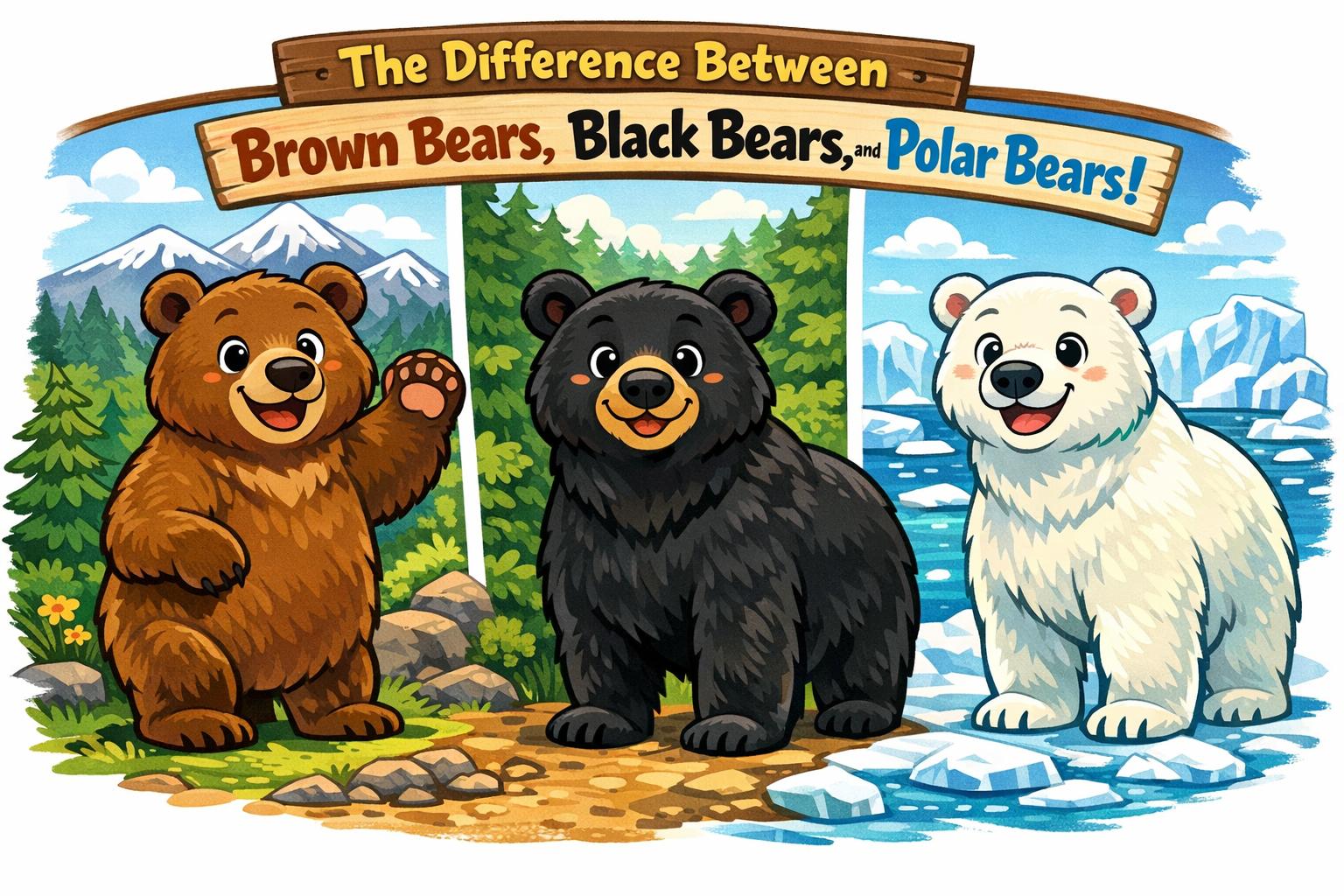
Bears are among the most recognizable large mammals on Earth, yet many people are unsure about the differences between brown bears, black bears, and polar bears. While they share a common ancestry and certain physical traits, each species has evolved distinct adaptations suited to different climates, food sources, and behaviors. Understanding these differences requires examining taxonomy, physical characteristics, habitat, diet, and behavior in detail.
Taxonomy and Evolutionary Relationships
All three species belong to the family Ursidae, but they are classified as separate species. The brown bear (Ursus arctos) has the widest global distribution. The American black bear (Ursus americanus) is native to North America, while the polar bear (Ursus maritimus) is specialized for Arctic environments.
Genetic research shows that polar bears evolved from brown bear ancestors approximately 400,000 to 500,000 years ago. Despite their different ecological niches, brown bears and polar bears remain closely related and can interbreed. Hybrids, sometimes called “pizzly” or “grolar” bears, have been documented in northern Canada. These cases demonstrate the relatively recent evolutionary divergence between the two species.
Black bears, meanwhile, diverged earlier and developed separate evolutionary paths in forested habitats across North America.
Physical Characteristics
Size and Build
One of the most noticeable differences is overall size. Polar bears are the largest terrestrial carnivores. Adult males commonly weigh between 900 and 1,600 pounds (400–700 kg), with exceptional individuals exceeding this. They have long necks, narrow heads, and elongated bodies that enhance swimming efficiency.
Brown bears vary considerably in size depending on subspecies and location. Coastal brown bears in Alaska, often referred to as grizzly bears when inland, may weigh 600 to over 1,200 pounds (270–540 kg). Interior grizzlies are usually smaller. Brown bears possess a prominent shoulder hump made of muscle, which aids in digging.
Black bears are generally smaller. Adult males often weigh between 200 and 600 pounds (90–270 kg), though size varies with food availability. They lack the shoulder hump that characterizes brown bears and have a straighter facial profile.
Claws and Limbs
Claw structure reflects feeding behavior. Brown bears have long, curved claws designed for digging roots and excavating dens. Black bears have shorter, more curved claws suited for climbing trees, an ability they use both for foraging and avoiding danger. Polar bears have large, partially webbed paws with shorter claws that provide traction on ice and help in swimming.
Fur and Coloration
Despite their names, color is not always a reliable identifier. Black bears may be black, brown, cinnamon, or even blond. Brown bears range from dark chocolate to light tan. The term “grizzly” refers to the silver-tipped guard hairs that give some brown bears a grizzled appearance.
Polar bears appear white, but their fur is actually translucent. Beneath this fur is black skin that absorbs solar radiation. Their dense underfur and thick fat layer provide insulation in temperatures that can fall below −40°C.
Habitat and Geographic Distribution
Brown Bears
Brown bears have one of the largest distributions of any bear species. They are found in North America, Europe, and Asia. Significant populations exist in Alaska, western Canada, Russia, and parts of Eastern Europe. In the continental United States, populations are primarily limited to the northern Rocky Mountains and parts of Wyoming and Montana. More details on their distribution can be found through the U.S. Fish and Wildlife Service.
They occupy diverse habitats, including coastal rainforests, alpine meadows, tundra, and forested mountain regions. Their adaptability contributes to their broad distribution.
Black Bears
Black bears are found exclusively in North America, from northern Canada through much of the United States and into northern Mexico. They thrive primarily in forested environments, including deciduous, coniferous, and mixed forests. Although once heavily persecuted, black bear populations are currently stable or increasing in many regions.
Their adaptability allows them to survive near suburban areas, which has increased human-bear interactions in recent decades.
Polar Bears
Polar bears inhabit the circumpolar Arctic, including regions of Canada, Greenland, Russia, Alaska, and Norway. They are strongly associated with sea ice, which they use as a platform for hunting seals. According to the International Union for Conservation of Nature (IUCN), polar bears are classified as vulnerable due to sea ice decline linked to climate change.
Unlike brown and black bears, polar bears rarely venture far inland. Their ecology revolves around marine environments.
Diet and Feeding Behavior
Brown Bears: Omnivorous Generalists
Brown bears are highly omnivorous. Their diet includes berries, grasses, roots, insects, fish, carrion, and large mammals such as moose or elk. Coastal populations in Alaska rely heavily on salmon runs, which provide critical fat reserves before hibernation.
This flexibility allows brown bears to adjust their diet seasonally and geographically. In years with strong salmon returns, body mass and reproductive success often increase.
Black Bears: Opportunistic Foragers
Black bears follow a similar omnivorous pattern but consume a higher proportion of plant material. Berries, nuts, and vegetation dominate much of their diet. They also eat insects, small mammals, and carrion. In suburban environments, unsecured garbage and bird feeders frequently become food sources.
Black bears are agile climbers and often forage in trees for nuts or escape threats by ascending trunks.
Polar Bears: Specialized Carnivores
Polar bears are the most carnivorous of all bear species. Their primary prey consists of ringed and bearded seals. They hunt seals at breathing holes in sea ice or by breaking into seal dens.
The high-fat diet of marine mammals is critical for survival in the Arctic. Polar bears rarely consume vegetation, and while they may scavenge whale carcasses or occasionally eat bird eggs, these foods do not replace the caloric value of seals.
Behavior and Social Structure
All three species are generally solitary outside of mating season and cub rearing. However, behavior varies according to environment and food availability.
Brown bears may congregate at concentrated food sources such as salmon streams. These gatherings are structured around dominance hierarchies. Larger males typically control the most productive fishing spots.
Black bears, being smaller, are more likely to avoid confrontation. In areas where both black and brown bears exist, black bears often retreat to denser forests.
Polar bears are widely dispersed due to the distribution of sea ice and seals. Encounters between individuals are infrequent except during mating season or at large carcasses.
Hibernation and Seasonal Adaptations
Brown and black bears enter a state of winter dormancy commonly referred to as hibernation. During this period, heart rate and metabolism decrease significantly, though body temperature drops only moderately. They survive on stored body fat for several months.
Pregnant females give birth in dens during winter. Cubs nurse while the mother remains in a fasting state.
Polar bears do not hibernate in the same way. Adult males and nonpregnant females remain active throughout winter, as seal hunting continues year-round. Only pregnant females den for extended periods, similar to brown and black bears.
Reproduction and Lifespan
All three species exhibit delayed implantation. After mating in spring or early summer, the fertilized egg does not immediately implant in the uterus. Implantation occurs in autumn if the female has accumulated sufficient fat reserves.
Cubs are born small and helpless. Litter sizes typically range from one to three. Mothers invest heavily in cub rearing, often keeping offspring with them for two to three years.
In the wild, black bears may live over 20 years, brown bears into their late twenties, and polar bears around 20–25 years, though lifespan depends heavily on environmental pressures and human impacts.
Interaction with Humans
Human interactions differ among species. Black bears are most frequently encountered due to their widespread distribution and ability to adapt to developed areas. Most conflicts involve food conditioning rather than predation.
Brown bears, particularly grizzlies, are responsible for a small number of serious attacks in North America each year. Defensive encounters typically occur when a bear is surprised at close range or when a sow is protecting cubs.
Polar bear attacks are rare but potentially predatory. In the Arctic, humans may represent a food source if other prey is unavailable. As sea ice declines, encounters in northern communities may increase.
Conservation Status
Black bears are generally considered secure across much of their range. Brown bear conservation status varies regionally. Some populations in Europe and the contiguous United States remain threatened, while Alaskan and Russian populations are stable.
Polar bears face the most significant long-term threat due to climate change. The reduction of sea ice directly affects hunting opportunities and body condition. Ongoing research monitors population trends, sea ice patterns, and reproductive success to assess future stability.
Key Distinctions in Ecological Roles
Ecologically, black and brown bears function as omnivorous ecosystem engineers. By dispersing seeds through scat and disturbing soil while digging, they shape plant communities. Their predation and scavenging influence prey populations and nutrient cycling.
Polar bears occupy a more specialized apex predator role within the Arctic marine ecosystem. Their dependence on seals ties their survival directly to oceanic and ice dynamics.
Conclusion
While brown bears, black bears, and polar bears share a common ancestry and certain structural similarities, their differences are substantial. Brown bears are powerful, adaptable omnivores distributed across multiple continents. Black bears are smaller, forest-adapted generalists found only in North America. Polar bears are Arctic specialists, highly carnivorous and uniquely dependent on sea ice.
Recognizing these distinctions clarifies not only identification in the wild but also the ecological pressures each species faces. From forest ecosystems to Arctic sea ice, these bears represent three distinct evolutionary solutions to survival in challenging environments.