
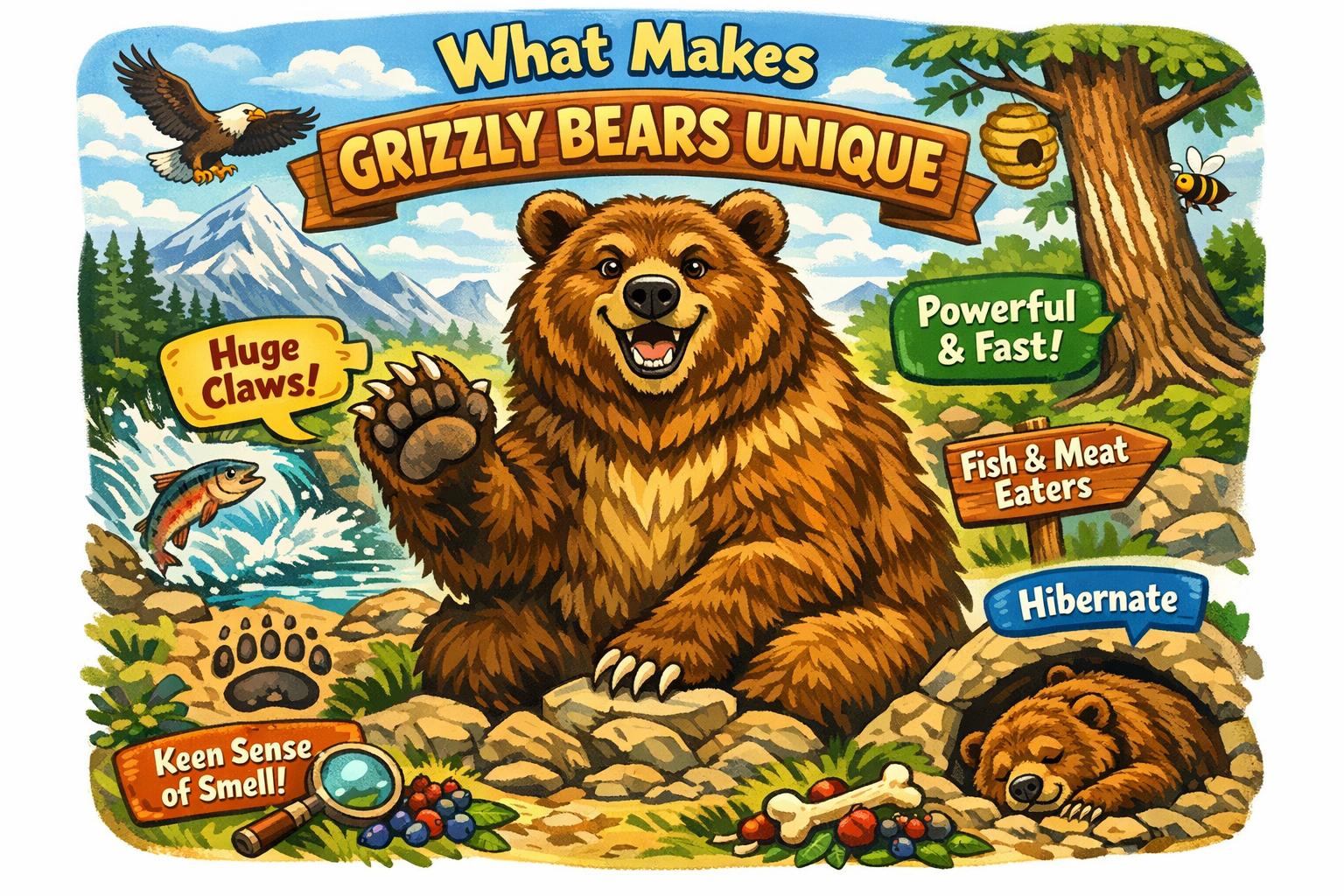
Grizzly bears are among the most studied large mammals in North America. A subspecies of the brown bear (Ursus arctos), the grizzly bear (Ursus arctos horribilis) occupies a specific ecological and geographic niche that sets it apart from other brown bear populations worldwide. While closely related to coastal brown bears of Alaska and even the massive Kodiak bear, grizzlies possess a distinct combination of physical traits, behaviors, ecological roles, and evolutionary adaptations that make them unique.
Taxonomy and Classification
Grizzly bears belong to the family Ursidae, which includes eight living species worldwide. Within the brown bear species, there are several recognized subspecies distributed across North America, Europe, and Asia. The grizzly is the most widely known interior North American brown bear. Coastal brown bears, though genetically similar, are usually larger due to richer food supply.
The scientific classification of the grizzly bear reflects its connection to other brown bears, yet differences in skull shape, body size, coloration, and habitat use support its distinct regional identity. More information on brown bear taxonomy can be found through the IUCN Red List, which assesses the global conservation status of the species.
Physical Characteristics
The Shoulder Hump
One of the most recognizable features of grizzly bears is the prominent muscular hump located above the shoulders. This hump is composed of powerful muscle mass attached to elongated vertebral spines. It provides exceptional digging strength, allowing grizzlies to excavate roots, bulbs, ground squirrel burrows, and winter dens.
This anatomical adaptation distinguishes them from American black bears, which lack such a pronounced shoulder structure. The hump serves as a field identification marker for wildlife observers and researchers.
Claws and Forelimb Strength
Grizzly bear claws are long, slightly curved, and can measure up to four inches. These claws are lighter in color and significantly longer than those of black bears. They are adapted for digging rather than climbing. As a result, adult grizzlies are less agile in trees compared to black bears.
The forelimbs of a grizzly possess immense strength. This strength supports digging, flipping over large rocks, dismantling logs to reach insects, and subduing prey such as elk calves or moose.
Size and Regional Variation
Grizzly bears show substantial variation in size depending on habitat and food availability. Interior grizzlies in the Rocky Mountains typically weigh between 300 and 600 pounds, though large males (boars) can exceed 700 pounds. In contrast, coastal brown bears may surpass 1,000 pounds due to salmon-rich diets.
The generally smaller body mass of interior grizzlies is directly connected to lower caloric intake compared to coastal relatives.
Geographic Distribution
Historically, grizzly bears ranged across much of western North America, from Alaska down through the Great Plains and into northern Mexico. Today, their distribution is significantly reduced.
In the contiguous United States, grizzlies primarily inhabit parts of:
Greater Yellowstone Ecosystem
Northern Continental Divide Ecosystem (Montana)
Cabinet-Yaak Ecosystem
Selkirk Ecosystem
Canada maintains larger populations in British Columbia, Alberta, the Yukon, Northwest Territories, and parts of northern Manitoba.
The U.S. Fish and Wildlife Service provides updated recovery and management information for grizzlies in the lower 48 states.
Habitat Preferences
Grizzlies are adaptable but generally prefer wilderness areas with low human density. Their habitat often includes alpine meadows, coniferous forests, subalpine zones, river valleys, and open plains.
Seasonal movement is common. During spring, they concentrate in lower elevations where snow melts early and green vegetation emerges. In summer, they may move higher into alpine environments for foraging. In autumn, hyperphagia—a period of intensive feeding—drives them to exploit high-calorie food sources such as whitebark pine nuts, berries, and meat.
Diet and Feeding Strategy
Though classified as carnivores, grizzly bears are omnivorous generalists. Their diet varies by season and region.
Plant-Based Foods
Vegetation constitutes a significant portion of a grizzly’s annual diet. Common plant foods include grasses, sedges, roots, bulbs, berries, and seeds. Whitebark pine nuts are particularly important in the Greater Yellowstone region.
This heavy reliance on plant material contrasts with coastal brown bears, whose diets may include large amounts of salmon during spawning seasons.
Animal Protein
Grizzlies consume insects, especially army cutworm moths in alpine areas, as well as carrion, rodents, elk calves, deer fawns, and occasionally adult ungulates. In some regions, they scavenge winter-killed animals emerging from melting snow.
Their opportunistic feeding behavior is a defining trait. Rather than specializing narrowly, grizzlies adjust their diets according to seasonal and geographic food availability.
Behavioral Characteristics
Solitary Lifestyle
Grizzly bears are primarily solitary animals. Adult bears maintain overlapping home ranges but generally avoid one another except during mating season or when concentrated at rich food sites.
Communication between individuals occurs through scent marking, vocalizations, tree rubbing, and scratch marks. These signals reduce direct encounters and potential conflict.
Hibernation and Denning
One of the most remarkable characteristics of grizzlies is their winter dormancy period. Although often described as true hibernation, bears enter a specialized state of metabolic suppression rather than full hibernation.
During winter:
Heart rate drops significantly
Respiration slows
Body temperature decreases moderately
Unlike many hibernating mammals, grizzlies can awaken quickly if disturbed. Pregnant females give birth inside winter dens, typically in January or February, nursing their cubs until emerging in spring.
Reproductive Strategy
Grizzly bears reproduce at a relatively slow rate, which influences population recovery efforts.
Delayed Implantation
After mating in late spring or early summer, fertilized eggs undergo delayed implantation. Embryos implant in the uterine wall only if the female accumulates sufficient fat reserves by autumn. This adaptation ensures that cubs are born only when maternal condition supports survival.
Low Reproductive Output
Females typically give birth to one to three cubs every three to four years. Cubs remain with their mother for up to two years, learning essential survival skills such as food identification and risk avoidance.
The extended maternal care period distinguishes grizzlies from many medium-sized mammals and contributes to their vulnerability to human-caused mortality.
Intelligence and Cognitive Ability
Research indicates that grizzly bears possess advanced cognitive abilities. Observations suggest strong memory, spatial awareness, and problem-solving skills. They remember seasonal food locations and migration routes of prey species.
Studies of bear behavior in protected areas highlight their capacity to adapt quickly to environmental change. However, this same intelligence can lead to human-bear conflicts when bears associate people with food sources.
Ecological Role
Grizzly bears function as keystone species in many ecosystems. Their activities influence plant communities, prey populations, and nutrient cycles.
Nutrient Distribution
When grizzlies prey on ungulates or scavenge carcasses, they distribute nutrients through partial consumption and movement of remains. In areas where salmon are available, bears transport fish remains into forests, enriching soils with marine-derived nitrogen.
Seed Dispersal
By consuming berries and traveling long distances, grizzlies disperse seeds across wide territories. Seeds deposited in nutrient-rich scat often have high germination success.
This ecological engineering contributes to ecosystem stability and biodiversity.
Relationship With Humans
Grizzly bears hold a complex place in North American history. Indigenous cultures have long respected the bear as a symbol of strength and spiritual power. Archaeological and oral traditions describe coexistence that predates European settlement.
However, westward expansion in the 19th and early 20th centuries led to extensive habitat loss and direct killing through hunting, poisoning, and government predator control programs.
Conflict and Management
Today, wildlife agencies manage grizzly populations through science-based monitoring, habitat protection, and conflict mitigation programs. Measures include bear-resistant food storage, road access management, livestock compensation programs, and public education initiatives.
Grizzlies generally avoid humans but may react defensively if surprised at close range, particularly females with cubs. Defensive encounters account for most injuries rather than predatory attacks.
Conservation Status
Globally, brown bears are listed as Least Concern by the IUCN. However, regional populations, including some grizzly bear populations in the lower 48 states, have been classified as threatened under the U.S. Endangered Species Act.
Since listing in 1975, recovery efforts have led to population increases in key ecosystems. Despite improvements, habitat fragmentation, climate change, and genetic isolation remain long-term challenges.
Climate Change Impacts
Warming temperatures affect grizzlies indirectly through food sources. For example, whitebark pine decline due to insects and disease—exacerbated by climate change—reduces a high-calorie autumn food supply in the Greater Yellowstone region.
Loss of traditional foods can increase movement into lower elevations, potentially raising human-bear conflict rates.
Differences From Other Bear Species
When comparing grizzlies with other North American bears, several distinctions stand out.
Grizzly vs. Black Bear
Grizzlies have a shoulder hump, concave facial profile, and longer claws. Black bears lack a pronounced hump, have a straighter facial profile, and shorter, curved claws adapted to climbing.
Grizzly vs. Polar Bear
Polar bears (Ursus maritimus) are highly specialized marine predators dependent on sea ice. Grizzlies, in contrast, are terrestrial omnivores with flexible diets and habitat use.
Although hybridization between polar bears and grizzlies has been documented in northern Canada, the two species occupy generally distinct ecological niches.
Adaptability and Survival Strategies
Perhaps the most defining characteristic of the grizzly bear is adaptability. From arid interior mountain ranges to productive northern forests, grizzlies adjust foraging behavior, movement patterns, and denning strategies according to environmental constraints.
Their capacity to endure long winters without food, exploit diverse seasonal diets, and navigate large territories demonstrates an evolutionary strategy built on flexibility rather than specialization.
Conclusion
Grizzly bears are unique not because of a single trait, but because of a distinctive combination of anatomy, ecological function, behavioral strategy, and evolutionary history. The muscular shoulder hump, long claws, omnivorous flexibility, prolonged maternal care, and role as a keystone species all contribute to their identity within the broader brown bear lineage.
As apex omnivores of interior North America, grizzlies help shape landscapes and maintain ecological balance. Their continued survival depends on large, connected habitats and thoughtful management that balances human expansion with wildlife conservation.
Understanding what makes grizzly bears unique requires examining both their biological characteristics and their place in changing ecosystems. Ongoing research and conservation efforts will determine how this distinctive bear subspecies persists in the decades ahead.