
The most traded currencies on the FX market are the U.S. Dollar, the Euro, the Japanese yen, the Swiss franc, the Canadian dollar, and the British pound.
The Swiss franc is regarded by many as a sort of “neutral” currency. Part of this reputation comes from the fact that the Swiss National Bank actively takes steps to ensure that the franc only trades within a fairly small span. Combined with Switzerland´s long-term social and political stability, the Swiss franc has earned the image of being a safe haven within the FX market.
The Swiss franc is the currency and legal tender of both Switzerland and Liechtenstein. It is also legal tender in Campione d´Italia, an Italian exclave surrounded by the Swiss canton Ticino.
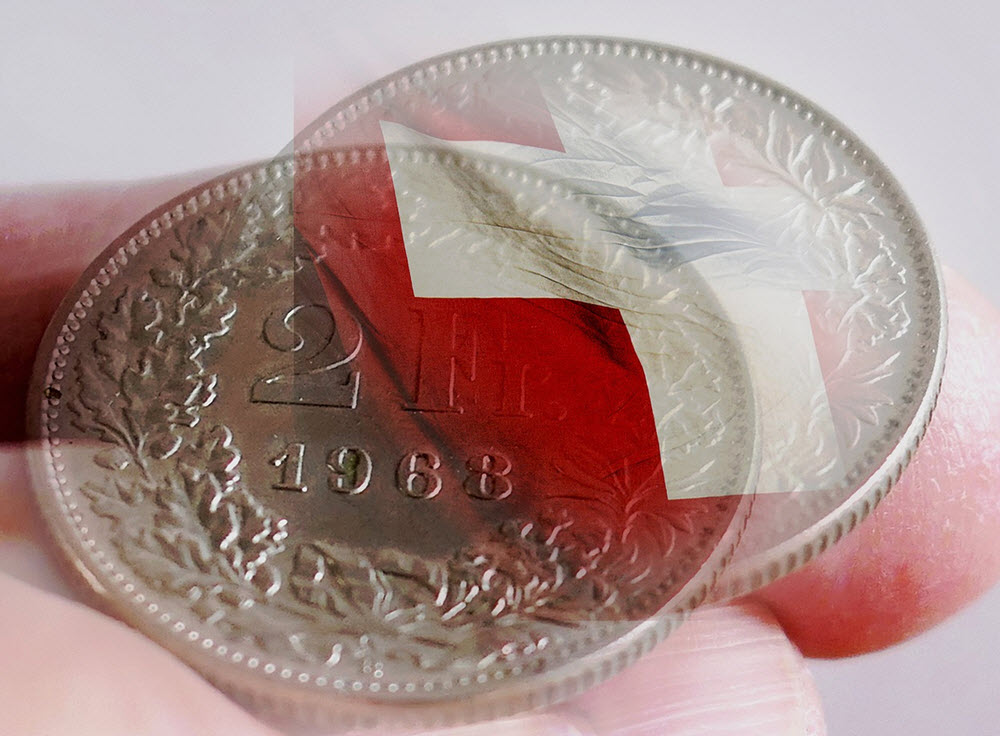
Short facts about the Swiss franc
- The ISO 4217 currency code for the Swiss franc is CHF. The CH stands for Confoederatio Helvetica, which is the Latin name for the Swiss Confederation.
- The Swiss National Bank (SNB) issues banknotes in CHF.
- The Swiss federal mint, which is named Swissmint, issues coins in CHF.
Denominations
The smaller denomination of the Swiss franc is 1/100 of a franc. It is named Rappen (Rp.) in German, centime (c.) in French, centesimo (ct.) in Italian, and rap (rp.) in Romansch.
Recent FX history
Chronology: The Rise & Evolution of the Swiss Franc (CHF)
From decentralized cantonal roots through the EUR/CHF cap interventions and modern policy shifts
Prior to 1850, over 8,000 distinct coins and banknotes circulated across cantons and private entities. The new Swiss Federal Constitution centralizes monetary authority, establishing the Swiss Franc pegged at parity to the silver French Franc.
Switzerland co-founds the LMU with France, Belgium, and Italy. Standardized gold and silver coins circulate interchangeably across borders until bimetallic strains and post-WWI inflation dissolve the union in 1926.
The Schweizerische Nationalbank (SNB) assumes exclusive monopoly rights over banknote issuance, replacing disparate cantonal commercial banks with centralized monetary management in Bern and Zurich.
The Federal Act on Banks and Savings Banks codifies strict statutory banking secrecy under Article 47, turning breaches into criminal offenses and making the Franc the undisputed global haven for private capital during geopolitical turmoil.
As the fixed dollar-gold peg fractures, the SNB abandons fixed intervention, allowing the Franc to float freely. Chronic global inflation triggers intense foreign capital inflows, establishing the Franc as a permanent anti-inflationary bastion.
Following a popular constitutional referendum, Switzerland becomes one of the last major global economies to sever the mandatory legal link requiring a minimum 40% gold reserve backing for circulating paper banknotes.
As the Greek sovereign debt crisis escalated in 2011, investors sought safety in the Swiss franc and the price of the CHF started rising steadily against the USD. The spread of the crisis to other parts of Europe, and the continuing debt crisis in the USA, helped fuel the situation. Before 2011 was over, the nominal short-term Swiss interest rates had become negative.
- March 2011: The franc climbed past US$1.10.
- June 2011: The franc climbed past US$1.20.
- August 2011: The franc climbed past US$1.30.
- August 2011 Measures: The Swiss National Bank (SNB) took measures to counteract what they called a “massive overvaluation” of the franc.
On 6 September 2011, the bank set a minimum exchange rate of 1.20 francs to the Euro, i.e. they capped the franc’s appreciation. Just before, the exchange rate was 1.095 CHF for 1 EUR, indicating that the Swiss franc would soon be on parity with the Euro. In conjunction with the capping, the SNB announced that they were prepared to buy foreign currency in unlimited quantities.
Within 15 minutes after the announcement, the exchange rate had changed from 1.12 CHF for 1 EUR to 1.22 CHF for 1 EUR, and the Swiss franc had also lost 9% against the U.S. dollar. On the day of the announcement, the CHF also fell at least 8.2% against all 16 of the most active currencies. This shocked some FX traders, who had previously regarded the franc as a safe haven, and who had not believed that the SNB would employ such effective measures.
In December 2014, the SNB tried to save its cap by introducing a negative interest rate on bank deposits, but to no avail.
SNB abandoned the cap on 15 January 2015, and the franc quickly increased in value by 30% against the euro. Among FX traders, the day became known as Francogeddon, as the plan to remove the cap had not been announced in advance. By the close of the trading day, the franc was up 23% against the euro and 21% against the U.S. dollar.
Several significant currency trading companies and spread-betting firms suffered major losses. Alpari, for instance, declared insolvency, FXCM needed to be bailed out by its parent company, and Global Brokers NZ announced that it could no longer meet the minimum capital requirements required by law.
After nearly eight years of negative interest rates designed to curb excessive foreign demand, the SNB hiked its benchmark policy rate back into positive territory, concluding its protracted negative-rate experiment as inflationary pressures returned globally.
The Swiss Federal Council, FINMA, and the SNB back an emergency acquisition of Credit Suisse by UBS, unlocking over 200 billion CHF in central bank liquidity lines to defend the national financial architecture and preserve systemic stability.