
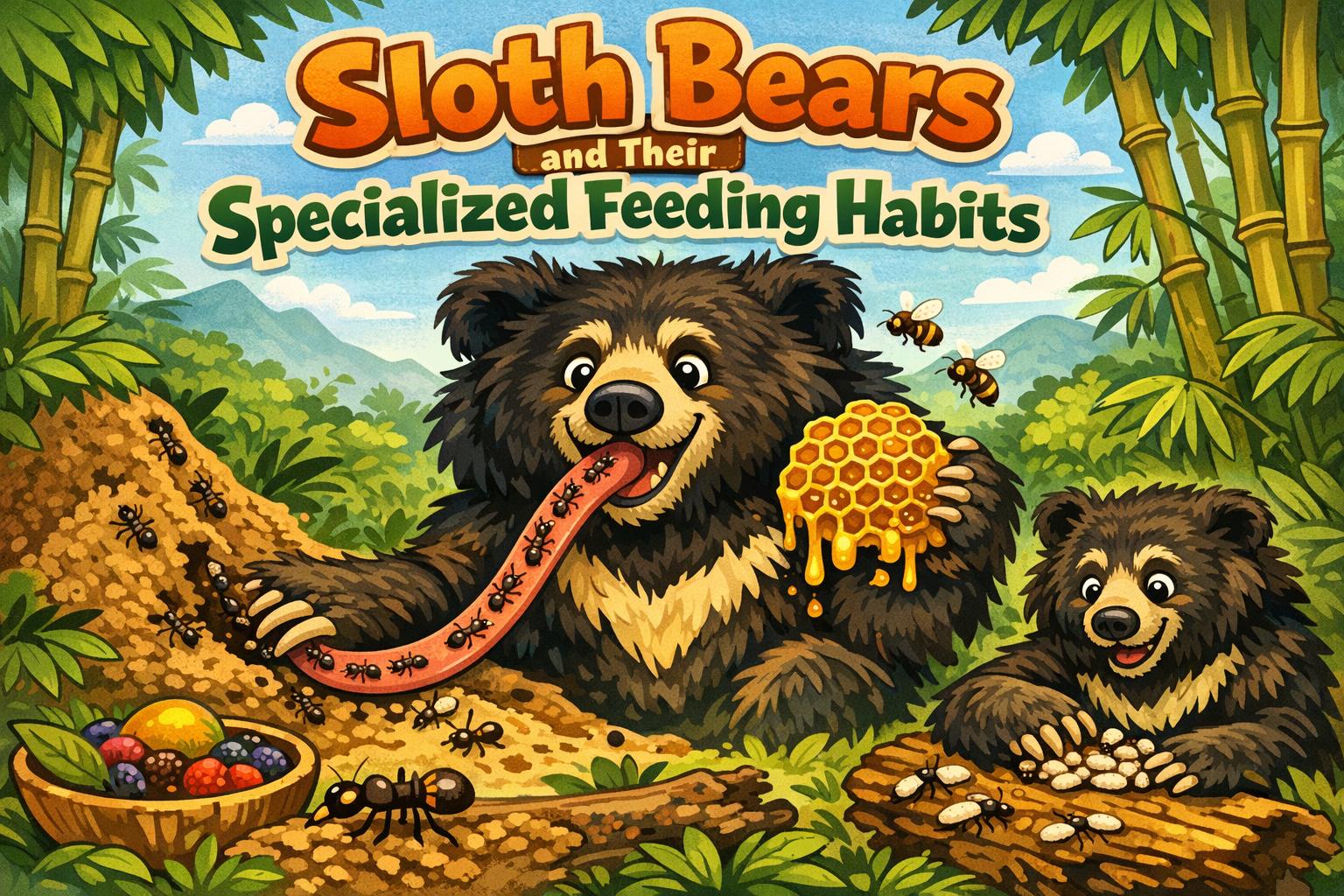
The sloth bear (Melursus ursinus) is one of the most specialized members of the bear family. Native to the Indian subcontinent, it has evolved feeding behaviors and anatomical traits that clearly distinguish it from other ursids. While many bear species are described as omnivorous generalists, the sloth bear demonstrates a high degree of dietary specialization, focusing heavily on social insects such as termites and ants. This specialization influences its anatomy, habitat use, daily activity patterns, and interactions with both ecosystems and human communities.
Geographic Distribution and Habitat Context
Sloth bears are found primarily in India, with smaller populations in Sri Lanka and Nepal. Their historical range once extended more widely across the Indian subcontinent, but habitat fragmentation and human expansion have reduced their distribution. According to the IUCN Red List, the species is currently listed as Vulnerable, largely due to habitat loss and human-wildlife conflict.
The habitats sloth bears occupy—including dry deciduous forests, scrublands, grasslands, and rocky outcrops—provide abundant insect colonies. Termite mounds are especially common in these environments. Unlike bears in colder climates, sloth bears do not hibernate, as their tropical and subtropical habitats offer year-round food resources. This continuous access to insects has allowed the species to refine feeding specializations rather than rely heavily on seasonal fat accumulation as seen in brown or black bears.
Anatomical Adaptations for Insectivory
The sloth bear’s feeding habits are reflected clearly in its morphology. Several anatomical traits are specifically adapted for extracting insects from nests and mounds.
Elongated Snout and Mobile Lips
One of the most distinctive features of the sloth bear is its elongated snout and highly flexible lips. The bear can close its nostrils voluntarily—an important adaptation when foraging in dusty termite mounds. Its lips form a tube-like structure, allowing it to create strong suction. Observers often note the loud sucking sound sloth bears produce when feeding, which can be heard from a considerable distance.
This suction ability is essential because termites and ants often retreat deep within narrow tunnels. Rather than relying solely on tongue extraction, the sloth bear vacuums insects directly into its mouth after breaking open the nest.
Reduced Upper Incisors
Unlike many mammals, the sloth bear lacks the usual pair of upper middle incisors. This gap enhances the efficiency of suction feeding. By reducing obstruction at the front of the mouth, the bear can draw insects in more effectively. This dental modification represents a clear evolutionary response to an insect-based diet.
Long, Curved Claws
Sloth bears possess long, sickle-shaped claws, particularly on their forelimbs. These claws are not primarily designed for tearing flesh or climbing trees—although they can climb when necessary—but are highly effective tools for digging into termite mounds and rotting logs. The claws enable rapid excavation, often breaking into hardened soil structures within minutes.
Shaggy Coat and Protective Features
The sloth bear’s shaggy black coat may also serve a protective function. When attacking insect nests, especially those of aggressive species, the long fur provides some barrier against bites and stings. The thick skin around the muzzle further reduces injury from defensive insect swarms.
Primary Diet Composition
Although sloth bears are classified as omnivores, insects form the core of their diet for much of the year. Termites are especially important during dry seasons when fruit availability declines.
Termites and Ants
Termites are rich in protein and fat relative to their size, making them a concentrated food source. Sloth bears locate termite colonies using their acute sense of smell, which is comparable to that of other bear species and capable of detecting food over great distances.
After identifying a colony, the bear uses its claws to rip open the mound. It then closes its nostrils, inserts its muzzle, and inhales forcefully. This feeding process can continue for extended periods at a single mound. Ant colonies are exploited in similar fashion, though sometimes with less excavation depending on nest structure.
Seasonal Fruits
During certain seasons, especially before and after the monsoon, fruits become more abundant and can make up a substantial portion of the sloth bear’s diet. Species such as mango, fig, and various forest berries are consumed opportunistically. Fruit consumption provides carbohydrates and helps balance nutritional needs.
Fruit-heavy diets influence the bear’s ranging behavior. In areas where fruiting trees are clustered, sloth bears may adjust their movement patterns accordingly.
Other Foods
Sloth bears occasionally consume honey, flowers, small vertebrates, and carrion. Honey is particularly attractive, and bears will break open beehives to access both larvae and honeycomb. Compared to brown bears or American black bears, however, sloth bears consume relatively little large animal prey.
Feeding Behavior and Foraging Strategy
Sloth bears are primarily nocturnal, especially in regions with significant human presence. Nighttime foraging reduces the risk of encounters with people and livestock. In more remote protected areas, they may also be active during early morning or late afternoon hours.
Their foraging strategy emphasizes olfactory exploration. With their heads lowered, sloth bears move slowly through habitat, frequently sniffing the ground or termite mounds. When an insect colony is located, feeding can be intense but localized.
Unlike bears that gather in large numbers at seasonal food bonanzas—such as salmon runs—sloth bears typically forage alone. Females with cubs are the primary social unit observed during feeding. Cubs often ride on their mother’s back, a behavior unusual among bears but well documented in this species. This behavior may protect cubs from predators such as tigers and leopards while the mother focuses on excavation and feeding.
Digestive Efficiency and Nutritional Considerations
Processing large quantities of insects requires a digestive system capable of handling chitin, the tough structural component of insect exoskeletons. While sloth bears do not possess highly specialized fermentation chambers like some insect-eating mammals, their digestive tracts are adapted to extract sufficient nutrients from crushed insects.
Studies analyzing scat samples show high proportions of insect remains during dry periods. Despite the relatively small size of individual insects, the cumulative caloric intake can support the bear’s moderate body mass, which typically ranges between 55 and 145 kilograms depending on sex and region.
Because insects are abundant year-round in many parts of the sloth bear’s habitat, the species does not need to accumulate extreme fat reserves. Consequently, sloth bears do not enter winter dormancy. This sets them apart from temperate bear species described by organizations such as the National Geographic Animal Encyclopedia.
Ecological Role
Sloth bears influence ecosystem structure through their feeding activity. By breaking open termite mounds, they modify soil composition and create microhabitats that may benefit other species. Excavated mounds can be used by small mammals, reptiles, or invertebrates seeking shelter.
In addition, fruit consumption makes sloth bears effective seed dispersers. Seeds that pass through their digestive system may germinate in new locations, contributing to forest regeneration. Though insectivory dominates much of their feeding ecology, this seasonal frugivory adds an important ecological dimension.
Human Interactions Linked to Feeding Habits
Feeding behavior can also influence human-sloth bear conflict. In agricultural areas, sloth bears may be drawn to crops such as sugarcane or fruit orchards. Their strong claws and digging behavior can damage property when searching for food. Furthermore, their habit of foraging in scrub near villages sometimes leads to close encounters.
Sloth bears have a reputation for defensive aggression, particularly when surprised at close range. Much of this behavior is associated with sudden encounters during foraging. Because they often feed with heads down and focus intently on the ground, they may not perceive approaching humans until distance is minimal.
Conservation programs increasingly emphasize habitat preservation and community education to reduce these encounters. Maintaining intact forest zones with adequate natural insect populations can help reduce the need for bears to enter cultivated landscapes.
Comparisons with Other Bear Species
Examining the sloth bear in the broader context of the family Ursidae highlights the extent of its specialization. Brown bears (Ursus arctos) and American black bears (Ursus americanus) display flexible diets that shift dramatically based on location and season. Polar bears (Ursus maritimus), by contrast, specialize in marine mammal predation.
The sloth bear occupies a distinct ecological niche as an insect-focused forager in tropical forests. Its dental reduction, snout elongation, nostril control, and suction capability collectively form a rare suite of adaptations within the bear family. Among large mammals, similar insect-feeding strategies are more commonly associated with anteaters or aardvarks than with bears.
Evolutionary Considerations
The evolutionary pathway that produced the sloth bear’s feeding adaptations likely involved gradual shifts toward insect exploitation in environments where large prey was scarce but insect colonies were plentiful. Over time, natural selection would have favored individuals with improved digging ability, better suction capacity, and reduced dental obstruction.
Genetic and fossil evidence indicates that sloth bears diverged relatively early from other Asian bear lineages. Their specialization suggests a long period of adaptation to ecological conditions unique to the Indian subcontinent. Further research into bear phylogeny continues to refine our understanding of these relationships.
Conclusion
The sloth bear demonstrates how dietary specialization can shape nearly every aspect of a mammal’s biology. From its elongated muzzle and reduced incisors to its nocturnal foraging patterns and ecological impact, the species is tightly linked to its primary food sources—termites and ants. While it remains an omnivore capable of dietary flexibility, the structural and behavioral traits associated with insect feeding define its identity within the bear family.
Understanding these specialized feeding habits is essential for conservation planning. Protecting habitats rich in insect populations, minimizing conflict in agricultural areas, and preserving forest connectivity all support the ecological needs of this distinctive bear. As pressures on South Asian ecosystems increase, detailed knowledge of species such as the sloth bear becomes increasingly important for informed management and long-term survival.