
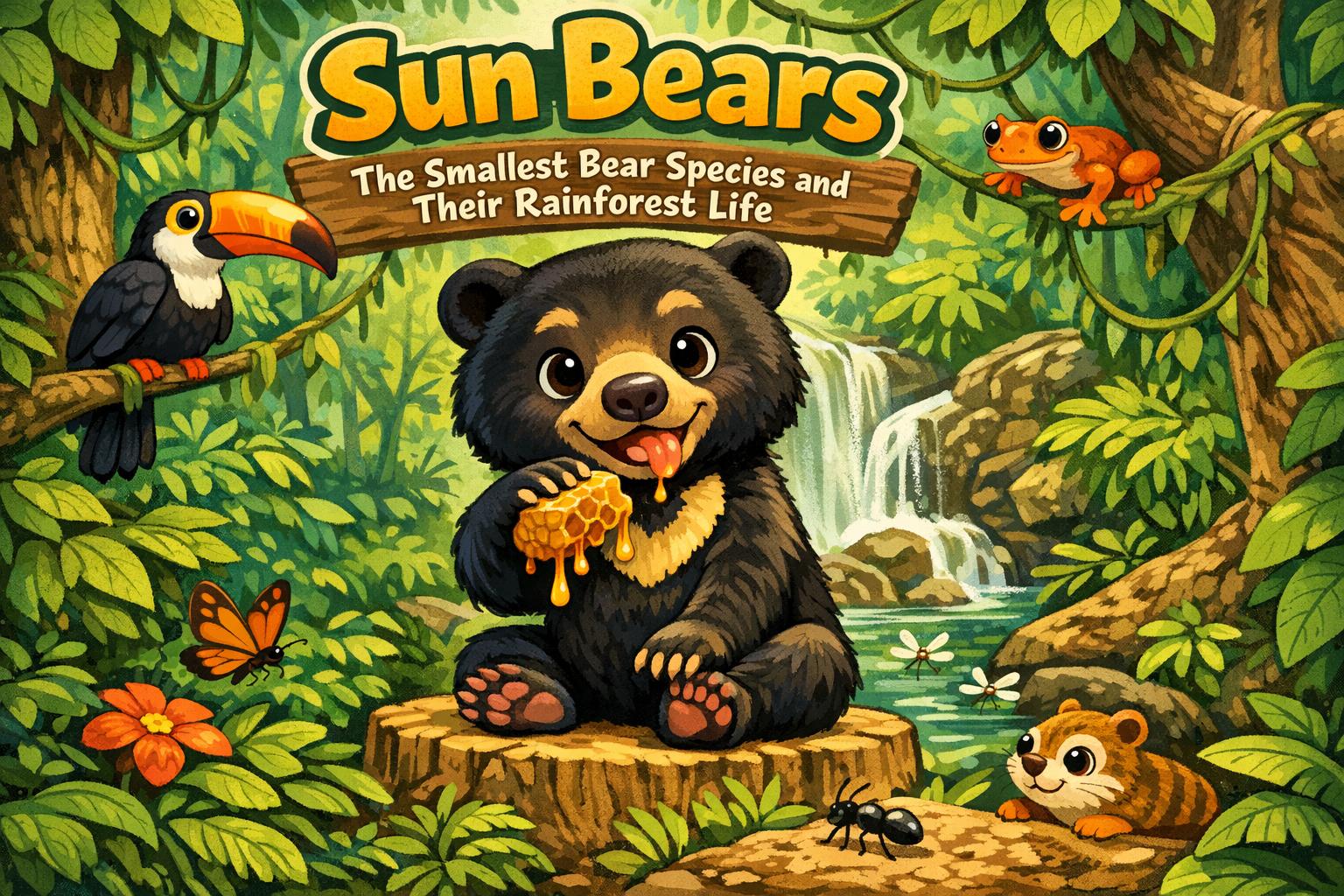
The sun bear (Helarctos malayanus) is the smallest living bear species and one of the least understood. Native to the tropical forests of Southeast Asia, it differs markedly from the larger and more familiar bear species of North America and Eurasia. Despite its modest size, the sun bear plays a significant ecological role in rainforest ecosystems. Its behavior, anatomy, and feeding habits reflect strong adaptation to warm, humid environments and dense forest habitats. This article examines the sun bear’s physical characteristics, habitat, diet, behavior, reproduction, conservation status, and relationship with humans.
Physical Characteristics and Adaptations
Adult sun bears typically weigh between 25 and 65 kilograms, though large males may exceed this range. They measure about 120 to 150 centimeters in body length, with a shoulder height of roughly 70 centimeters. Compared to other bears, they have a compact, muscular build with relatively short fur that ranges from black to dark brown.
A defining feature is the pale, crescent-shaped marking on the chest, which varies in color from cream to orange. This marking is thought to serve as a visual signal during social encounters. The species’ common name refers to this chest patch, which resembles a rising sun.
The sun bear has several specialized adaptations for rainforest life. Its tongue can extend up to 25 centimeters, enabling it to extract insects and honey from crevices. The jaws are powerful relative to body size, and the canine teeth are strong enough to tear into wood. The claws are long, curved, and well suited for climbing trees and breaking open logs. Unlike bears in temperate climates, sun bears do not hibernate because food is available throughout the year in equatorial forests.
Distribution and Habitat
Sun bears are distributed across Southeast Asia, including southern Myanmar, Thailand, Laos, Cambodia, Vietnam, Peninsular Malaysia, Sumatra, and Borneo. Their range once extended more widely across the region, but habitat fragmentation has reduced their distribution in many areas.
The species inhabits tropical evergreen rainforests, seasonal forests, and sometimes swamp forests. It is typically found in lowland forest habitats, though it can occur at elevations up to 2,100 meters in some mountainous areas. Dense understory vegetation and abundant fruiting trees are important components of suitable habitat.
Sun bears rely heavily on forest cover for foraging, resting, and protection. Deforestation driven by logging, agricultural expansion, and oil palm cultivation has significantly reduced available habitat. According to the IUCN Red List, habitat loss remains one of the primary threats to the species.
Diet and Foraging Behavior
The sun bear is an omnivore with a diet that shifts according to seasonal availability. Fruit forms a major component of its diet, especially figs and other soft fruits common in Southeast Asian forests. When fruit is abundant, sun bears may feed extensively in the canopy.
Insects are another important food source. Using their powerful claws and jaws, sun bears tear open rotting logs and termite mounds to access ants, termites, beetle larvae, and other invertebrates. The elongated tongue helps extract insects from narrow spaces.
They also consume honey, small vertebrates, birds’ eggs, and occasionally carrion. While not specialized predators of large mammals, they may opportunistically hunt small animals such as rodents or lizards. Their strong sense of smell is essential for locating food, particularly underground insects or concealed nests.
Sun bears contribute to forest regeneration by dispersing seeds through their droppings. Fruits consumed in one location may be deposited elsewhere, assisting plant reproduction and maintaining forest diversity.
Behavior and Social Structure
Sun bears are generally solitary animals, except for mothers with cubs or during brief mating interactions. They maintain home ranges that may overlap, but individuals typically avoid direct contact. Communication occurs through scent marking, vocalizations, and body postures.
Unlike many other bear species that exhibit seasonal dormancy, sun bears remain active year-round. They are primarily diurnal but may become more nocturnal in areas with frequent human disturbance. Activity patterns are influenced by food availability and local environmental conditions.
Sun bears are skilled climbers and spend considerable time in trees. They often construct sleeping platforms by bending or breaking branches, forming a nest-like structure above the ground. These structures provide resting sites and may also serve as feeding platforms when fruit is abundant.
Although generally shy and elusive, sun bears can display defensive aggression if threatened. Standing on hind legs is common during alert or defensive situations and allows them to better assess their surroundings.
Reproduction and Life History
Reproductive biology in sun bears differs somewhat from that of temperate bear species. Because they live in tropical environments without strongly defined seasons, breeding can occur at various times of the year. However, local peaks in mating activity may coincide with periods of food abundance.
After a gestation period of approximately 95 to 100 days, females typically give birth to one or two cubs. Cubs are born blind and largely hairless, weighing about 300 to 400 grams. As in other bear species, maternal care is extensive. Cubs remain with their mother for up to two years, learning essential foraging and climbing skills.
Sexual maturity is generally reached between three and four years of age. Data on lifespan in the wild are limited, but captive individuals have been documented living over 25 years. Mortality factors in the wild include predation on cubs by large carnivores and, more significantly, human-related pressures.
Ecological Role in Rainforest Ecosystems
Though small compared to other bears, sun bears are influential components of their ecosystems. As both predators of insects and consumers of fruit, they occupy multiple trophic levels. By breaking apart decaying wood during foraging, they facilitate nutrient cycling and create microhabitats for other organisms.
Seed dispersal is among their most important functions. Tropical forests depend on animals to transport seeds away from parent trees, reducing competition and promoting genetic diversity. The wide-ranging movements of sun bears support this ecological process.
Their excavation of termite mounds and logs may also influence insect populations and forest floor structure. These disturbances, while localized, contribute to habitat complexity in rainforest systems.
Conservation Status and Threats
The sun bear is currently classified as Vulnerable on the IUCN Red List. Population estimates are uncertain due to the species’ secretive nature and the difficulty of conducting research in dense forests. However, trends indicate a decline across much of its range.
Primary threats include large-scale deforestation, illegal hunting, and wildlife trade. Forest conversion for agriculture, particularly oil palm plantations, has resulted in extensive habitat fragmentation. Infrastructure development further isolates populations, limiting gene flow and increasing vulnerability.
Sun bears are hunted for several reasons. In some regions, body parts are used in traditional medicine. Cub capture for the pet trade also occurs, often involving the killing of the mother. Additionally, bears may be killed in retaliation when they forage in agricultural areas.
Organizations such as the World Wildlife Fund and local conservation groups support habitat protection, anti-poaching initiatives, and community outreach. Protected areas across Borneo and Sumatra provide important refuges, though enforcement varies widely.
Research and Monitoring Challenges
Studying sun bears presents logistical challenges. Their low population density, cryptic behavior, and forested habitats make direct observation rare. Researchers rely on camera traps, radio telemetry, and genetic analysis of hair and fecal samples to gather data.
Compared to species such as the American black bear or brown bear, scientific knowledge about sun bear population size and structure remains limited. Expanding research is critical for informed management decisions.
Recent technological advances, including satellite tracking and improved camera trap networks, are enhancing understanding of movement patterns and habitat use. Long-term monitoring projects are beginning to clarify seasonal diet shifts and reproductive timing.
Human Interaction and Cultural Context
In parts of Southeast Asia, sun bears have cultural significance in folklore and indigenous traditions. However, rapid economic development has altered traditional relationships between humans and wildlife.
Human-bear conflict tends to arise near agricultural frontiers, where bears may feed on cultivated fruit or sugar-rich crops. Such incidents are generally limited compared to conflicts involving larger bear species, but they can still influence local tolerance toward wildlife.
Environmental education programs aim to reduce conflict by promoting secure crop storage, community-based monitoring, and awareness of the ecological role of bears. Successful conservation depends not only on protected areas but also on cooperation with local communities.
Comparison with Other Bear Species
Within the family Ursidae, the sun bear is unique in both size and ecological specialization. It shares its tropical distribution with the sloth bear (Melursus ursinus) in parts of Asia, but differs in morphology and diet. The sloth bear is more specialized for termite feeding and occupies more open habitats in South Asia.
In contrast to the large-bodied brown bear (Ursus arctos) of northern latitudes, sun bears lack adaptations for cold climates. Their short fur and absence of fat accumulation for hibernation reflect a stable thermal environment. This distinction illustrates how bear species have diversified to occupy a wide range of ecological niches.
Future Outlook
The long-term survival of the sun bear depends primarily on forest conservation. Maintaining large, connected habitats is essential for sustaining viable populations. International cooperation is necessary because the species’ range spans multiple national boundaries.
Improved land-use planning, enforcement of anti-poaching laws, and support for sustainable forestry can mitigate current threats. Continued ecological research will further clarify the species’ requirements and inform conservation strategies.
As the smallest bear species, the sun bear receives less public attention than larger and more charismatic relatives. Yet its ecological role in tropical rainforests is significant. Protecting the sun bear contributes not only to biodiversity conservation but also to the preservation of Southeast Asia’s remaining rainforest ecosystems.
Understanding the biology and environmental importance of Helarctos malayanus remains a developing field. Ongoing research, combined with habitat protection and community engagement, will determine whether this distinctive rainforest bear maintains a stable future in the wild.