
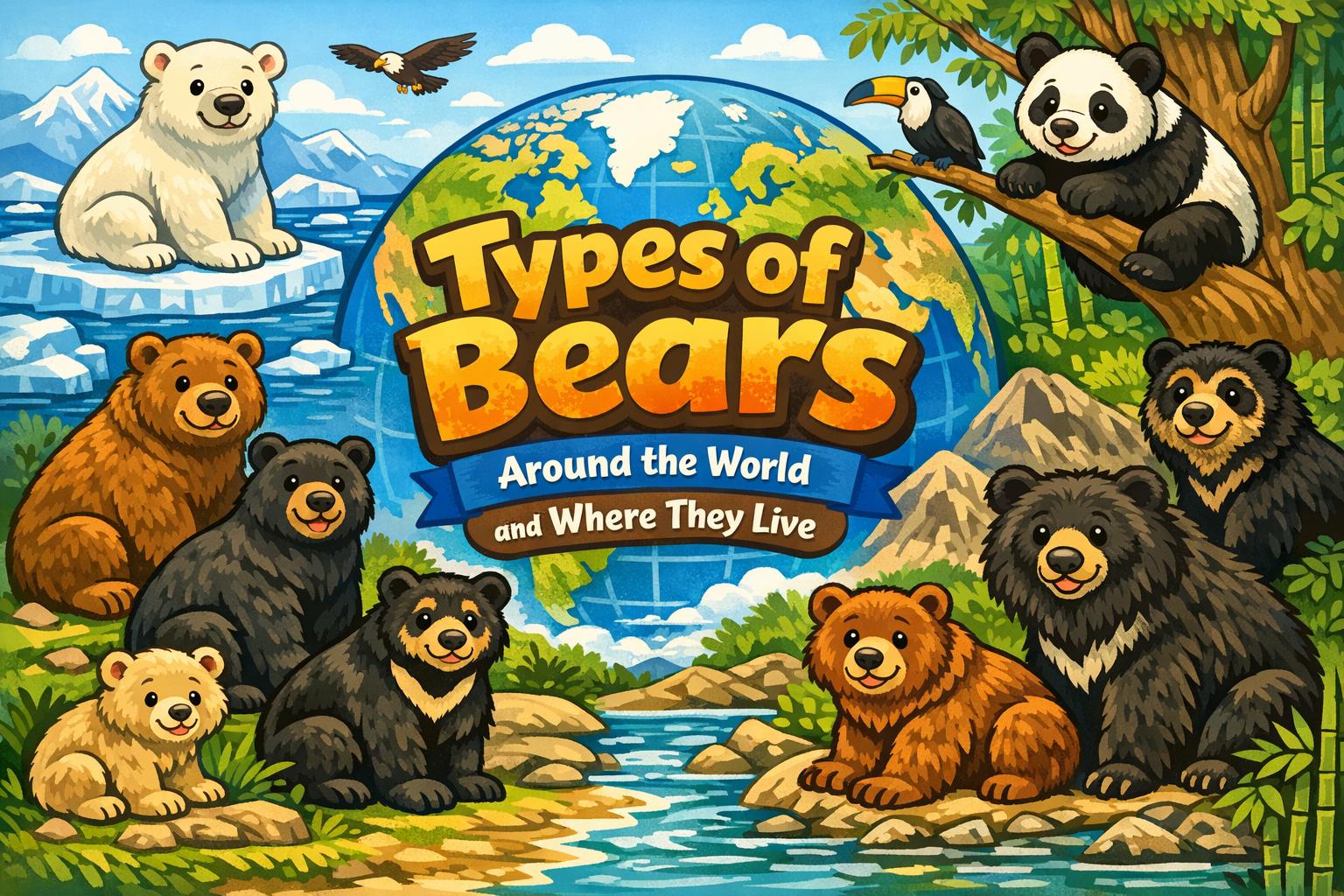
Bears belong to the family Ursidae, a group of large, primarily omnivorous mammals found across the Northern Hemisphere and parts of South America. Although often grouped together in popular imagination, the world’s eight bear species differ significantly in distribution, habitat preference, diet, and conservation status. Understanding where each species lives helps explain how bears have adapted to environments ranging from Arctic sea ice to tropical forests.
Family Ursidae: An Overview
The bear family includes eight living species distributed across North America, South America, Europe, and Asia. Bears evolved from ancestral carnivores approximately 20 million years ago. Today, they occupy diverse ecological niches. While most species are omnivores, dietary composition varies significantly depending on habitat and seasonal food availability.
Bears typically require large home ranges, low levels of human disturbance, and stable food sources. Habitat fragmentation and climate change are affecting many species. Conservation assessments by organizations such as the International Union for Conservation of Nature (IUCN) provide updated information on population trends and threats.
American Black Bear (Ursus americanus)
The American black bear is the most widely distributed bear species in North America. Its range extends from northern Canada and Alaska through the United States and into northern Mexico. This species occupies a broad variety of habitats, including deciduous forests, coniferous forests, swamps, and even areas near human settlements.
Despite its name, the American black bear’s coat color ranges from black to brown, cinnamon, and occasionally white (as in the Kermode bear of British Columbia). Forested environments with abundant mast crops—such as acorns and berries—are particularly important. In mountainous regions, black bears use elevation gradients seasonally, moving to lower elevations in autumn.
Due to adaptable feeding behavior and flexible habitat use, the American black bear remains classified as Least Concern globally, though some local populations face habitat fragmentation.
Brown Bear (Ursus arctos)
The brown bear is among the most widespread terrestrial carnivores in the Northern Hemisphere. Its distribution spans North America, Europe, Russia, Central Asia, China, and parts of the Middle East. Several recognized populations or subspecies fall under this category, including the grizzly bear of North America and the Kodiak bear of Alaska.
Brown bears inhabit diverse environments. In North America, grizzlies occupy interior forests, alpine meadows, and tundra regions from Alaska to parts of the northwestern United States. In coastal Alaska, Kodiak bears benefit from abundant salmon runs, allowing for larger average body size.
Across Eurasia, brown bears range from the forests of Scandinavia to the taiga of Siberia and mountainous areas such as the Carpathians. Habitat preference typically includes forested landscapes with access to open feeding areas. Russian populations represent the largest continuous brown bear population in the world.
Polar Bear (Ursus maritimus)
The polar bear is uniquely adapted to life in the Arctic. Its range is restricted to circumpolar regions surrounding the Arctic Ocean, including parts of Canada, Greenland, Norway (Svalbard), Russia, and Alaska. Unlike other bears, polar bears rely heavily on sea ice as a hunting platform.
Polar bears primarily prey on seals, particularly ringed and bearded seals. Their distribution closely follows sea ice coverage, which fluctuates seasonally. Pregnant females den on land or stable ice sheets, often in snowdrifts along coastal areas.
Climate change significantly impacts polar bear habitat. Shrinking sea ice reduces access to prey and increases energy expenditure. As a result, the species is listed as Vulnerable by the IUCN. More information about Arctic conservation can be found through the World Wildlife Fund.
Asian Black Bear (Ursus thibetanus)
The Asian black bear, also known as the moon bear due to the white crescent marking on its chest, ranges across southern Asia. Its distribution includes Iran, the Himalayas, northern India, China, Korea, Japan, and parts of Southeast Asia.
This species primarily inhabits forested mountain regions, often at moderate to high elevations. Seasonal altitudinal migration is common. During warmer months, Asian black bears move to higher elevations to feed on fruits and vegetation. In colder periods, they descend to lower forested areas.
Deforestation and illegal wildlife trade present significant threats. Habitat overlap with dense human populations contributes to human-bear conflict in several regions. The species is currently listed as Vulnerable.
Giant Panda (Ailuropoda melanoleuca)
The giant panda is taxonomically a bear, though its diet and ecological specialization differ markedly from other species. Native to central China, particularly Sichuan, Shaanxi, and Gansu provinces, the panda inhabits temperate mountain forests between 1,200 and 3,500 meters in elevation.
Bamboo makes up over 99 percent of the giant panda’s diet. These forests must provide several bamboo species to ensure year-round food availability. Pandas rely on dense understory vegetation for shelter and thermal regulation.
Conservation initiatives in China have stabilized some populations through habitat corridors and protected reserves. The species’ conservation status has improved from Endangered to Vulnerable in recent years, reflecting coordinated government efforts.
Sun Bear (Helarctos malayanus)
The sun bear is the smallest bear species and inhabits tropical forests of Southeast Asia. Its range includes Thailand, Malaysia, Indonesia (including Borneo and Sumatra), Myanmar, Cambodia, Laos, Vietnam, and southern China.
Sun bears prefer lowland dipterocarp forests but can also be found in secondary forests and mountainous areas. They rely heavily on insects such as termites and ants, as well as fruit and honey. Their long tongues and strong claws are adaptations to this feeding style.
Widespread deforestation for palm oil plantations significantly reduces suitable habitat. As a result, sun bears are classified as Vulnerable.
Sloth Bear (Melursus ursinus)
The sloth bear occupies the Indian subcontinent, including India, Sri Lanka, Nepal, and Bhutan. It primarily inhabits dry forests, grasslands, scrublands, and rocky outcrops.
This species specializes in feeding on termites and ants. Its elongated snout and mobile lips allow it to extract insects efficiently. Sloth bears often inhabit areas with seasonal water sources and forest cover sufficient for denning.
Human population density within its range is high, and habitat fragmentation is common. Sloth bears frequently occupy landscapes shared with agriculture and villages, increasing the likelihood of encounters. The species is currently listed as Vulnerable.
Spectacled Bear (Tremarctos ornatus)
The spectacled bear, also called the Andean bear, is the only bear species native to South America. Its range extends along the Andes Mountains from Venezuela through Colombia, Ecuador, Peru, Bolivia, and into northwestern Argentina.
It inhabits diverse elevations, from cloud forests to high-altitude grasslands known as páramo. Spectacled bears are primarily herbivorous, feeding on fruits, bromeliads, and vegetation, though they occasionally consume small mammals.
Habitat fragmentation due to agriculture and infrastructure development affects Andean populations. Protected areas within the Andes are vital for long-term survival. The species is categorized as Vulnerable.
Geographic Patterns in Bear Distribution
With the exception of the spectacled bear in South America, all bear species are native to the Northern Hemisphere. Asia hosts the greatest diversity, with six species: brown bear, Asian black bear, sun bear, sloth bear, giant panda, and populations of the polar bear in the far north.
North America supports three native species: American black bear, brown bear (including grizzlies and Kodiaks), and polar bear. Europe primarily hosts brown bears, with fragmented populations in southern and eastern regions.
Bear absence in Africa, Australia, and Antarctica reflects evolutionary history and continental isolation. Fossil evidence indicates that extinct bear species once had broader distributions, but climatic changes and competition influenced present-day ranges.
Habitat Requirements and Adaptations
Although habitat types differ dramatically among species, several common features characterize suitable bear environments. These include adequate food availability, denning sites, seasonal refuges, and minimal human disturbance.
In temperate and boreal forests, mast-producing trees and salmon streams are important. In tropical systems, fruiting trees and insect availability shape habitat selection. In Arctic ecosystems, sea ice determines polar bear distribution.
Many bears exhibit seasonal hibernation or torpor, particularly in northern climates. During winter, food scarcity leads bears to den in sheltered locations such as caves, hollow trees, or excavated ground dens.
Conservation and Human Interaction
Six of the eight bear species are classified as Vulnerable or higher on the IUCN Red List. Primary threats include habitat loss, poaching, climate change, and conflict with humans.
Large home ranges mean that infrastructure development—roads, railways, urban expansion—frequently fragments bear habitat. Poaching for body parts, particularly in Asia, continues to affect Asian black bears and sun bears.
Conservation strategies typically involve protected areas, wildlife corridors, research monitoring, and community-based conflict mitigation. Regions such as Alaska and parts of Canada maintain stable bear populations through regulated wildlife management.
Conclusion
The eight species of bears occupy a broad geographic range, from Arctic sea ice to tropical rainforests and high Andean cloud forests. Each species demonstrates adaptations to its environment, whether through dietary specialization, seasonal migration, or hibernation patterns.
While some populations remain stable, many bears face increasing ecological pressures. Continued habitat protection, scientific monitoring, and responsible wildlife policy are essential to ensure that bears persist throughout their natural ranges. Understanding where bears live—and why they live there—provides the foundation for meaningful conservation efforts worldwide.