
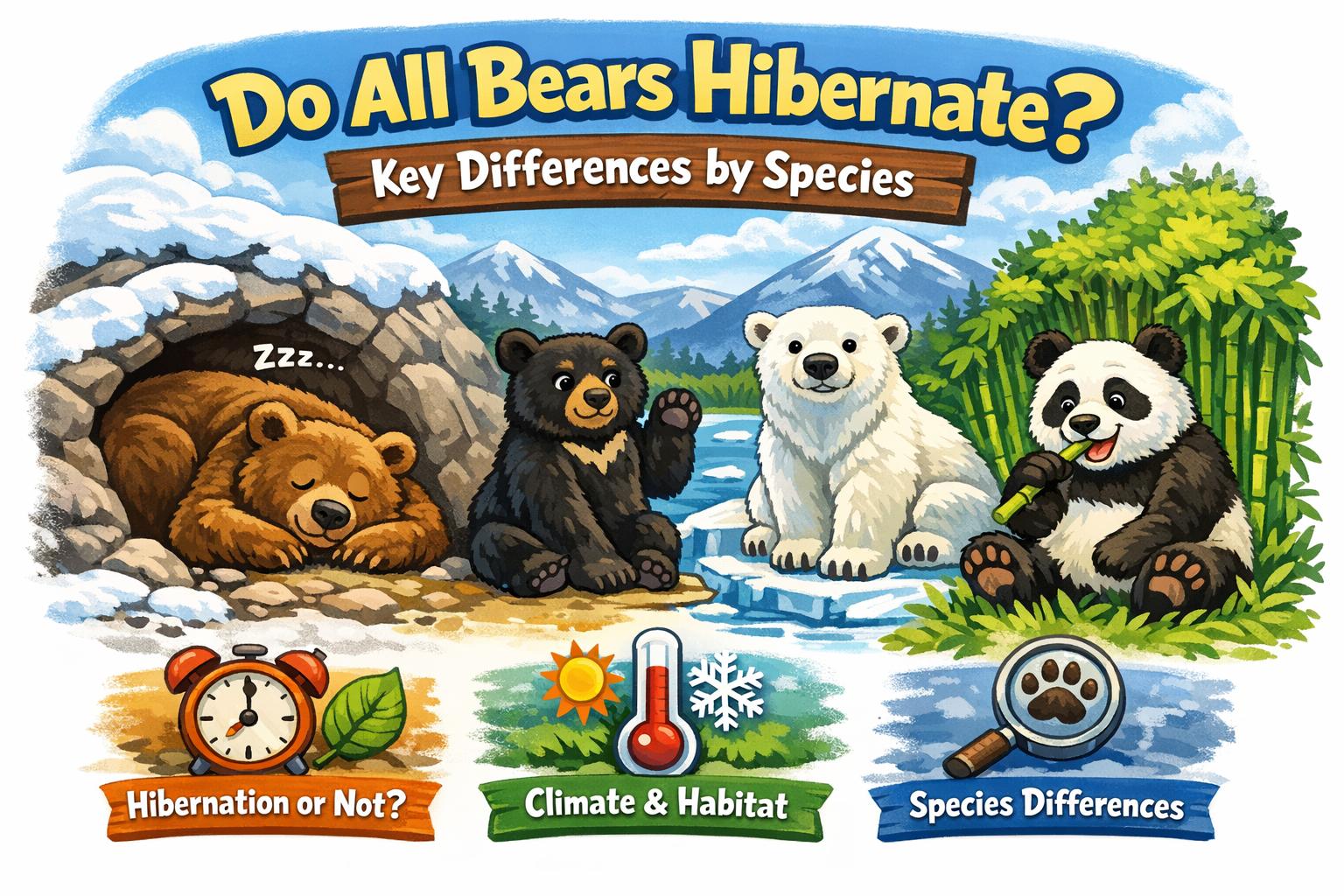
Bears are commonly described as hibernating animals, but the reality is more complex. Not all bears hibernate, and even among those that do, hibernation varies significantly by species, geography, climate, and food availability. In scientific terms, bears do not enter “true hibernation” in the same way as ground squirrels or bats. Instead, they undergo a prolonged winter dormancy with unique physiological adaptations. Understanding how this process differs among species clarifies why the simple statement “all bears hibernate” is inaccurate.
What Is Hibernation in Bears?
Before comparing species, it is important to define what hibernation means in the bear context. True hibernators drastically lower their body temperature to near freezing, and their metabolic rate drops to just a few percent of normal. Bears, by contrast, reduce their metabolic rate by approximately 50–75%, but their body temperature decreases only moderately, typically by about 3–7°C (5–12°F).
During winter dormancy, a bear:
– Does not eat or drink
– Does not urinate or defecate
– Relies entirely on stored body fat
– Can wake relatively quickly if disturbed
This state is often called torpor rather than deep hibernation. However, in common language and most scientific literature, it is still referred to as hibernation. The physiological mechanisms behind this process continue to be studied, including muscle preservation and bone density retention. Research published by organizations such as the U.S. Geological Survey highlights how bears avoid muscle atrophy despite months of inactivity.
Species That Regularly Hibernate
Several bear species consistently enter winter dormancy in regions where winter food shortages occur. These species are primarily found in northern latitudes.
American Black Bear (Ursus americanus)
The American black bear is the most widely distributed bear species in North America. In northern regions such as Alaska, Canada, and the northern United States, black bears hibernate for up to seven months. In southern states like Florida or Louisiana, some individuals may only den for short periods or skip denning altogether.
Latitude strongly influences behavior. A black bear in Minnesota may enter a den in October or November and emerge in April. In contrast, a black bear in southern Mexico might remain active year-round.
Black bears prepare for dormancy through hyperphagia, a period of excessive feeding in late summer and fall. During this phase, they can consume 15,000–20,000 calories per day. Fat accumulation is critical because body fat becomes the sole energy source throughout winter.
Brown Bear (Ursus arctos)
Brown bears, including grizzly bears and Kodiak bears, also hibernate in northern climates. In Alaska, they may remain in dens for six to eight months. Coastal brown bears with access to late salmon runs may enter dens later than inland populations.
Pregnant females typically den earlier and emerge later than males. They give birth during winter dormancy, usually in January, and nurse cubs inside the den for several months before emerging in spring.
European brown bears exhibit similar patterns. In Scandinavia, denning can last five to seven months, depending on snow cover and temperature. The National Geographic species profile on brown bears provides additional regional context.
Asian Black Bear (Ursus thibetanus)
Asian black bears show variable denning behavior depending on latitude and elevation. In northern parts of their range, such as northeastern China or the Russian Far East, they hibernate consistently. In more temperate regions, including parts of Japan and the Himalayas, denning may be shorter or conditional.
In tropical portions of Southeast Asia, winter dormancy is minimal or absent. Food availability remains sufficient year-round in many low-elevation forests.
Species That Rarely or Never Hibernate
Not all bear species experience seasons severe enough to require winter dormancy.
Polar Bear (Ursus maritimus)
Polar bears are the clearest example of a large bear species that does not undergo typical hibernation. Adult males and non-pregnant females remain active throughout winter. They continue hunting seals on sea ice even during the coldest months.
Pregnant females, however, do enter maternity dens. They excavate snow dens in late autumn, give birth during winter, and remain inside until cubs are strong enough to travel. This behavior resembles hibernation, but it is limited to reproductive females and is not a universal species trait.
Polar bear physiology differs from that of other bears because Arctic prey remains available year-round. According to the National Geographic polar bear profile, their survival strategy depends more on sea ice stability than on seasonal fat storage cycles associated with typical hibernation.
Sun Bear (Ursus malayanus)
Sun bears inhabit tropical forests of Southeast Asia. Seasonal temperature variation is limited, and food sources such as fruit, insects, and honey remain accessible throughout the year. As a result, sun bears do not hibernate.
They may reduce activity during extended rainfall or food shortages, but they do not enter prolonged dormancy. Their smaller body size and tropical habitat eliminate the environmental pressures that drive winter denning in northern species.
Sloth Bear (Melursus ursinus)
Sloth bears, native to the Indian subcontinent, also remain active year-round. Their diet consists largely of termites, ants, and fruit. These food sources are available in most seasons within their range. Consequently, they have not evolved the metabolic adaptations associated with winter hibernation.
Short-term resting in sheltered locations occurs, particularly during extreme heat, but this is not comparable to winter dormancy.
Geographic Variation Within a Single Species
One of the most important points in understanding bear hibernation is that hibernation is strongly influenced by environment rather than species identity alone. Within the same species, behavior can differ dramatically.
American black bears provide the clearest example. In northern Canada, deep snow and subfreezing temperatures eliminate access to vegetation and mast crops. Hibernation becomes necessary. In southern Florida, where temperatures remain mild and some food sources persist year-round, bears may remain active through winter.
Similarly, brown bears in coastal Alaska with prolonged salmon runs may delay denning compared to interior populations where food becomes scarce earlier in autumn.
This variation demonstrates that bear dormancy is a flexible adaptation rather than a fixed biological rule.
Physiological Differences Between Bear Species
Although not all bears hibernate, those that do share remarkable biological mechanisms.
Metabolism and Energy Use
Hibernating bears rely entirely on fat metabolism. They enter dormancy with substantial fat reserves and break down triglycerides slowly over several months. Unlike humans in prolonged inactivity, bears maintain muscle tissue and bone density.
Research suggests that nitrogen recycling mechanisms allow bears to reuse urea to build proteins, reducing muscle loss. This adaptation has attracted biomedical interest for potential human medical applications.
Heart Rate and Breathing
During denning, a black bear’s heart rate may drop from 40–50 beats per minute to as low as 8–10 beats per minute. Breathing slows accordingly. However, body temperature does not fall to near-freezing levels as in small mammals.
Responses vary somewhat by species size and climate severity. Larger brown bears in colder environments may exhibit longer uninterrupted dormancy compared to black bears in milder climates.
Reproduction and Birth Timing
Species that hibernate in winter commonly synchronize reproductive timing with dormancy. Fertilized eggs undergo delayed implantation. Actual fetal development begins only after the female enters the den.
This pattern is observed in American black bears, brown bears, and Asian black bears in colder regions. In contrast, tropical species that do not hibernate display less rigid seasonal reproductive timing.
Climate Change and Changing Hibernation Patterns
Climate change is influencing bear dormancy patterns in measurable ways. Warmer autumns and delayed snowfall have shortened hibernation periods in some regions. Studies in Colorado and Alberta indicate that black bears are entering dens later and emerging earlier than several decades ago.
Reduced snowpack may decrease den insulation, potentially affecting cub survival rates. For polar bears, the issue is different: reduced sea ice limits feeding opportunities rather than altering classic hibernation, which most individuals do not perform.
These shifts demonstrate that bear dormancy remains closely tied to environmental conditions.
Key Differences by Species
The central differences regarding hibernation among bear species can be summarized through patterns rather than rigid categories:
Northern temperate and Arctic-adjacent forest species — including American black bears, brown bears, and some Asian black bear populations — typically undergo several months of winter dormancy due to seasonal food scarcity.
Arctic marine specialists — polar bears — remain active year-round except for pregnant females.
Tropical forest species — sun bears and sloth bears — do not hibernate because food resources remain available throughout the year.
Within these broad patterns, local climate and geography strongly modify behavior.
Conclusion
The statement “all bears hibernate” oversimplifies a diverse and environmentally driven set of behaviors. Not all bears hibernate, and among those that do, hibernation varies in timing, duration, and physiological depth.
American black bears and brown bears in northern climates routinely enter winter dormancy lasting up to seven or eight months. Asian black bears may or may not hibernate depending on location. Polar bears typically remain active except for pregnant females in maternity dens. Sun bears and sloth bears do not hibernate at all due to stable tropical food supplies.
Bear hibernation is best understood as an adaptive response to seasonal food scarcity rather than a universal species trait. Differences across species reflect geography, climate, evolutionary history, and ecological niche. As global climates shift, these patterns continue to evolve, reinforcing the idea that bear dormancy is flexible rather than absolute.