
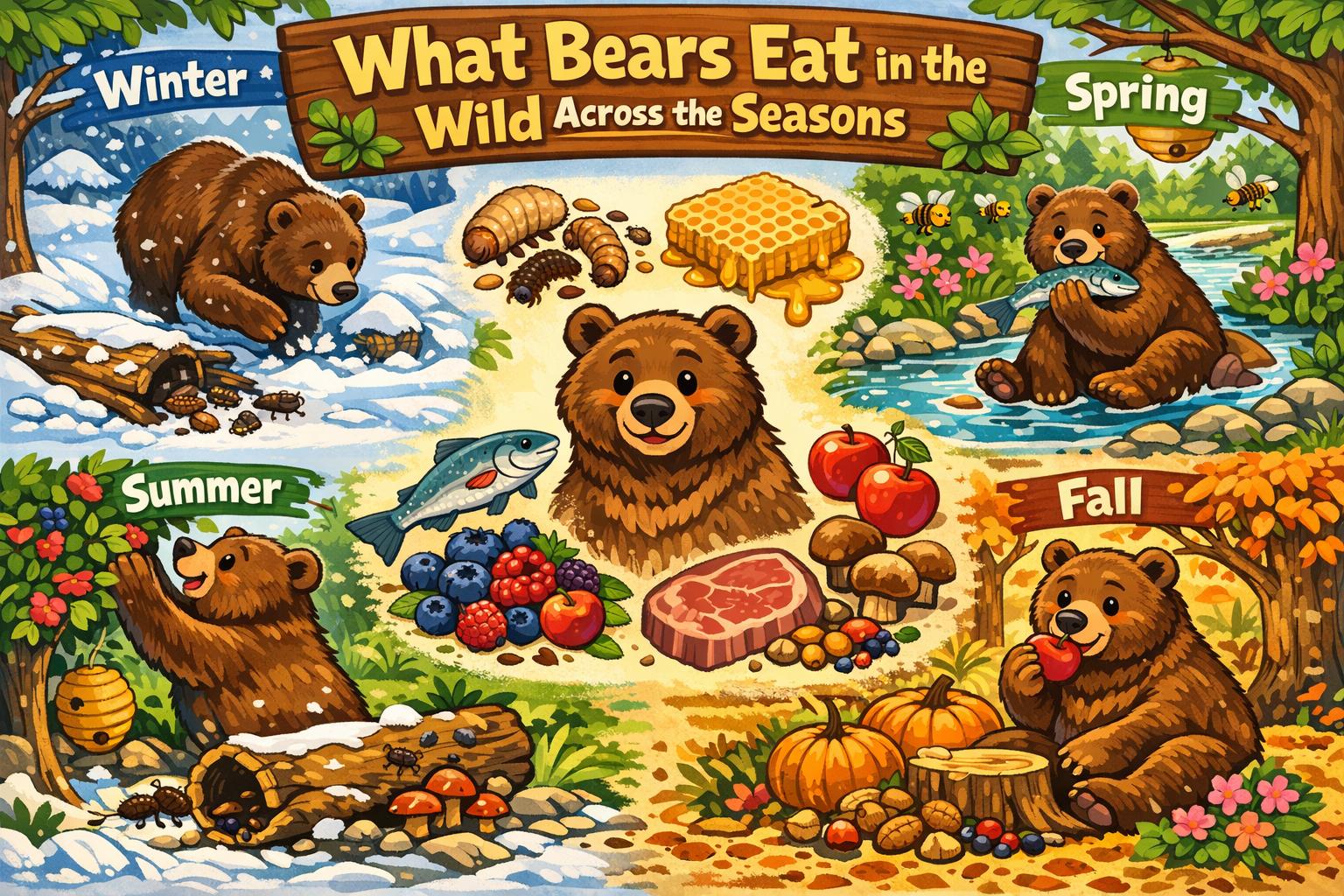
Bears are opportunistic omnivores whose diets shift continuously with the seasons, food availability, and their own biological needs. While popular imagery often emphasizes salmon-catching grizzlies or honey-raiding black bears, the reality is more complex. Across North America, Europe, and Asia, bear species adjust their feeding behavior to match plant growth cycles, animal migrations, and preparation for winter dormancy. Their survival depends not on a single preferred food, but on flexibility.
Spring: Emerging From Hibernation
When bears leave their dens in early spring, they are in a calorie deficit. Months of denning—during which their metabolism slowed and they neither ate nor drank—leave them in urgent need of energy. However, early spring offers limited food options in many northern habitats.
At this stage, bears primarily consume newly emerging vegetation. Fresh grasses, sedges, and shoots provide digestible nutrients. Riparian areas are especially important because they green up first. Studies summarized by the National Park Service show that spring diets of both American black bears (Ursus americanus) and brown bears (Ursus arctos) often consist largely of grasses and forbs.
Bears also feed on carrion during spring. Winter-killed ungulates such as deer, elk, or moose provide high-protein meals. In some ecosystems, bears actively search avalanche paths or valley bottoms where carcasses accumulate. Carrion is particularly important for large male brown bears emerging earlier than females with cubs.
In areas where prey species give birth in spring, bears may prey on neonatal ungulates. Moose calves, elk calves, and deer fawns are vulnerable during their first weeks of life. Research in Alaska and Yellowstone has shown that predation on young ungulates can form a significant part of spring nutrition for grizzly bears.
In coastal or southern regions, spring diets may expand to include spawning fish. For example, in parts of the Pacific Northwest, bears feed on early salmon runs or other fish species as they become available.
Early to Mid-Summer: Increasing Diversity
As temperatures rise, plant productivity increases. Summer marks a period of dietary expansion. Bears take advantage of herbaceous plants, roots, and a growing range of animal foods.
In many habitats, bears dig for roots, bulbs, and tubers. Brown bears in alpine and subalpine meadows excavate glacier lilies and other nutrient-rich plants. These plant parts often contain concentrated carbohydrates that support steady weight gain.
Insects become a substantial food source in summer. Bears frequently tear apart logs or flip rocks to access ants and beetle larvae. In some regions, such as the Rocky Mountains, aggregations of army cutworm moths provide high-fat nutrition. Grizzly bears may climb to alpine talus slopes to consume tens of thousands of moths per day during peak abundance.
American black bears in forested landscapes often consume colonial insects such as wasps and bees. While honey itself is calorie-dense, larvae are especially rich in protein and fat.
Fish consumption increases in areas with accessible streams and lakes. In Alaska, coastal brown bears time their movements to salmon runs. Interior populations may rely less on fish and more on vegetation and terrestrial prey. The nutritional differences are substantial; salmon-rich diets can lead to larger body sizes and higher cub survival.
Small mammals also contribute to summer diet. Bears opportunistically capture ground squirrels, marmots, or rodents. Though individually small in caloric value, these prey items supplement plant-based feeding.
Late Summer and Autumn: Hyperphagia
By late summer, bears enter a physiological state known as hyperphagia. During this period, they dramatically increase food intake to accumulate fat reserves for winter. Daily caloric consumption can reach 20,000 calories or more for large individuals.
Berries and soft mast become central to the diet of many bear populations. Blueberries, huckleberries, raspberries, crowberries, and elderberries are commonly consumed depending on region. These fruits are high in sugar and relatively easy to harvest in large quantities. In years of strong berry production, bears may spend much of the day foraging in concentrated patches.
Where available, hard mast such as acorns, beechnuts, and pine nuts is critical. In parts of North America, fluctuating acorn crops strongly influence black bear movements and reproductive success. Poor mast years often correlate with increased bear activity near human settlements as animals search more widely for food.
Salmon runs reach peak intensity in late summer and early fall in many northern ecosystems. Coastal brown bears often focus heavily on fish during this season. Interestingly, bears sometimes consume only specific parts of salmon—such as brains, skin, and roe—when fish are abundant. This selective feeding allows them to maximize fat intake while minimizing effort.
The ecological importance of salmon consumption extends beyond bear nutrition. When bears drag fish carcasses into forests, they transfer marine-derived nutrients into terrestrial ecosystems. Research documented by conservation organizations such as the World Wildlife Fund highlights how this nutrient cycling benefits plants and other wildlife.
In interior regions lacking salmon, bears may intensify hunting efforts for larger prey before winter. Adult brown bears occasionally prey on elk or moose, though such hunts are energetically costly and less common than plant feeding.
Winter: Denning and Fasting
During winter, bears in colder climates enter dens and undergo extended fasting. Contrary to common belief, bears are not true hibernators in the same sense as ground squirrels. Their body temperature decreases moderately rather than drastically, but their metabolism slows significantly.
Throughout denning, bears rely entirely on stored fat reserves. They do not eat, drink, urinate, or defecate. Fat metabolism provides both energy and metabolic water. Lean body mass is conserved to a remarkable degree.
Pregnant females give birth in the den, typically to one to three cubs. Lactation is fueled entirely by stored fat, making autumn hyperphagia especially important for reproductive females. In regions with milder winters, such as parts of the southern United States or coastal areas, some bears may remain partially active year-round if food remains accessible.
Regional Variations in Bear Diet
While seasonal patterns are broadly similar, diet varies by species and geography.
American Black Bears
Black bears are highly adaptable and often consume a predominantly plant-based diet. In many eastern forests, up to 75–90 percent of annual intake may consist of vegetation, fruits, and nuts. However, they readily exploit animal protein when available, including carrion, insects, and occasionally livestock or small mammals.
The adaptability of black bears has enabled them to occupy habitats ranging from Florida swamps to Canadian boreal forests. Their feeding flexibility also contributes to human–bear conflict where unsecured garbage, bird seed, or agricultural crops provide high-calorie substitutes for natural foods.
Brown Bears and Grizzlies
Brown bears exhibit significant dietary diversity depending on habitat. Coastal populations with access to salmon and intertidal foods (such as clams and sedges) tend to grow larger. Interior grizzlies rely more heavily on roots, berries, and occasional ungulate predation.
In alpine regions, brown bears dig extensively for burrowing mammals. In tundra landscapes, they may consume substantial amounts of crowberries and other low-growing plants during autumn.
Polar Bears
Polar bears (Ursus maritimus) differ markedly from other bears because they are primarily carnivorous. Their diet consists mainly of seals, especially ringed and bearded seals. Seasonal sea ice dynamics determine hunting success.
During ice-free periods, polar bears may scavenge whale carcasses, consume bird eggs, or eat limited vegetation, but these foods generally do not replace the caloric value of seal blubber. The IUCN Red List notes that declining sea ice affects feeding opportunities and overall body condition.
Nutritional Strategies and Digestive Adaptations
Bears possess digestive systems suited to omnivory. Their gastrointestinal tract is relatively simple compared to specialized herbivores, meaning they cannot efficiently digest highly fibrous plant material. Instead, they select easily digestible vegetation such as young shoots and berries.
Fat accumulation is central to seasonal survival. Subcutaneous and visceral fat layers can become several inches thick by autumn. This fat not only provides insulation but fuels metabolic processes during winter dormancy.
Behaviorally, bears maximize energy efficiency by adjusting foraging locations. When high-calorie foods are concentrated and predictable—such as salmon streams or berry slopes—bears reduce travel to conserve energy.
Human Influence on Seasonal Diet
Human activity increasingly shapes bear feeding patterns. In some agricultural regions, crops such as corn, oats, and sunflowers provide attractive autumn foods. Orchards and apiaries can also draw bears seeking concentrated sugars or protein.
Improperly stored garbage and outdoor pet food may become regular components of urban-edge bear diets. This adaptation can alter natural seasonal rhythms and increase risks for both humans and bears. Wildlife agencies consistently emphasize food storage practices to prevent conditioning bears to anthropogenic sources.
Climate change is also influencing seasonal availability of natural foods. Earlier springs can shift plant emergence. Altered precipitation patterns affect berry production. In Arctic regions, reduced sea ice limits polar bear access to seals during critical feeding times.
Conclusion
Across species and continents, bears survive through dietary flexibility. Spring diets often emphasize vegetation and carrion, summer brings insects and diverse plant resources, and autumn centers on intense calorie accumulation through berries, nuts, and fish. Winter fasting underscores the importance of seasonal fat storage.
Rather than fitting a single stereotype, bears function as adaptive generalists shaped by habitat, climate, and food cycles. Understanding what bears eat across the seasons helps explain their movements, reproductive success, and interactions with ecosystems—and with people. Their role as both predator and seed disperser, scavenger and nutrient transporter, reflects a feeding strategy grounded in opportunity rather than specialization.