
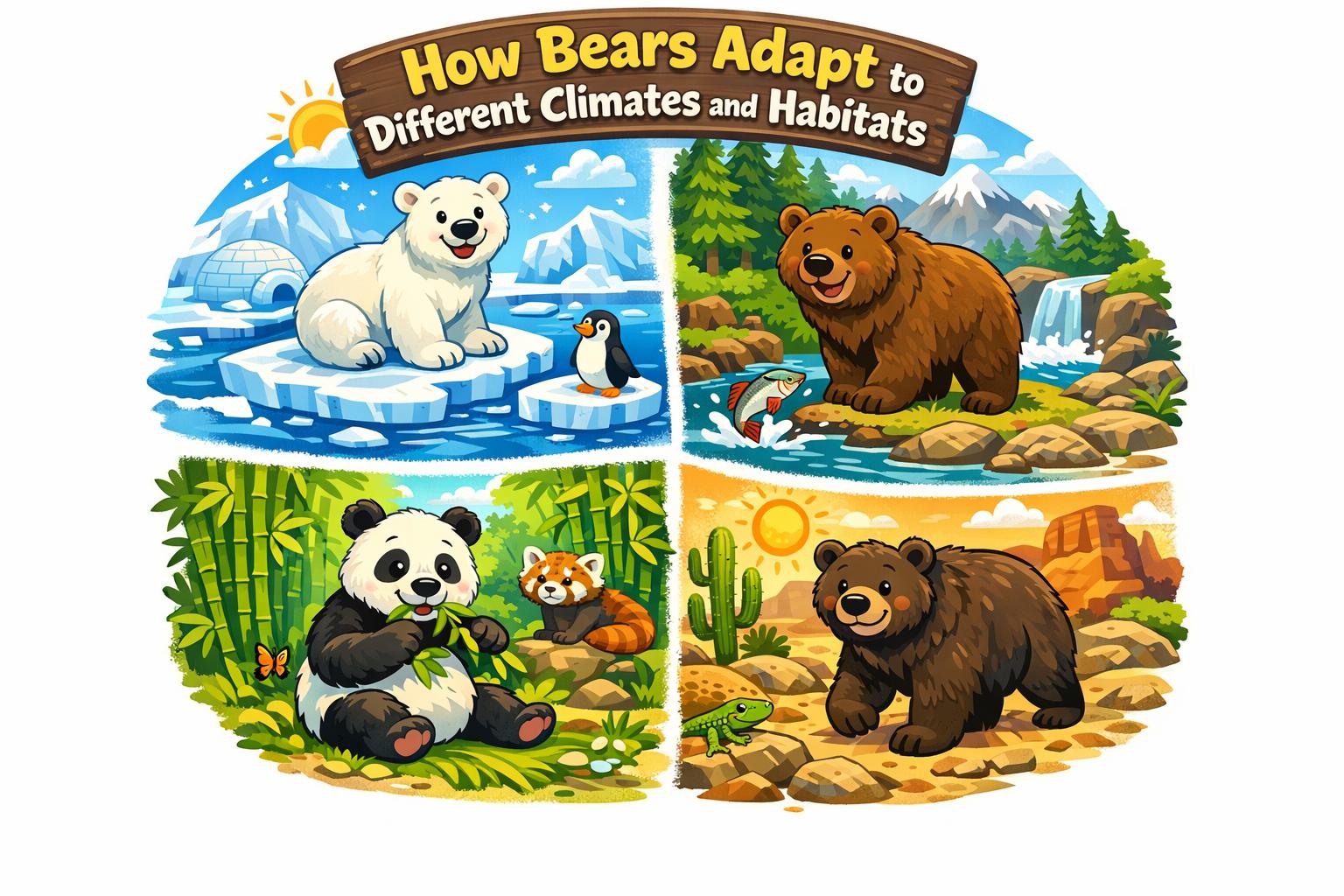
Bears occupy a remarkable range of environments across the Northern and Southern Hemispheres, from Arctic sea ice to tropical rainforests and high-altitude mountain forests. The family Ursidae includes eight living species, each shaped by evolutionary pressures that reflect local climate, food availability, competition, and seasonal variability. Their success across such diverse habitats is rooted in flexible physiology, adaptable behavior, and in some cases highly specialized anatomy. Understanding how bears adapt to different climates reveals broader ecological principles about large mammals and environmental change.
Global Distribution and Ecological Range
The eight extant bear species—polar bear (Ursus maritimus), brown bear (Ursus arctos), American black bear (Ursus americanus), Asiatic black bear (Ursus thibetanus), giant panda (Ailuropoda melanoleuca), sun bear (Helarctos malayanus), sloth bear (Melursus ursinus), and spectacled bear (Tremarctos ornatus)—demonstrate varying degrees of ecological flexibility. According to the IUCN Red List, several species face habitat-related pressures, yet their persistence in contrasting climates highlights their adaptive capacity.
Bears primarily inhabit North America, Europe, Asia, and parts of South America. Their absence from Africa and Australia in modern times reflects historical extinction and biogeographic processes rather than ecological limitation. Across continents, temperature regimes, snow cover, forest density, and prey distribution significantly influence how each species has evolved.
Physiological Adaptations to Cold Climates
Insulation and Fat Storage
Species living in cold or seasonally cold habitats, such as polar bears, brown bears, and American black bears, rely heavily on subcutaneous fat and dense fur for insulation. Polar bears possess a thick blubber layer that can exceed 10 centimeters, reducing heat loss in Arctic waters. Their fur consists of hollow guard hairs that trap air and enhance buoyancy while also providing insulation.
Brown bears and black bears, though less specialized for marine cold, accumulate significant fat reserves during periods of food abundance. This energy storage supports survival during winter months when food is scarce. Fat also functions as a critical metabolic resource during denning.
Hibernation and Torpor
In temperate and subarctic regions, winter food scarcity shapes bear physiology. Many species enter a state commonly described as hibernation, though bear hibernation differs from that of smaller mammals. Body temperature declines moderately rather than drastically, but heart rate and metabolic rate slow substantially. Brown and black bears may go months without eating, drinking, urinating, or defecating.
This adaptation allows survival in environments where winter eliminates plant growth and reduces prey availability. Unlike true hibernators, bears can awaken relatively quickly if disturbed, an advantage in unstable conditions.
Circulatory and Metabolic Adjustments
Research published through institutions such as the National Geographic Society and academic journals has shown that bears maintain muscle tone and bone density during denning. Special metabolic mechanisms recycle nitrogenous waste into usable proteins, reducing muscle atrophy. These adaptations are critical for large-bodied mammals that must resume foraging and territorial activity in spring.
Adaptations to Arctic Marine Environments
The polar bear represents the most specialized climatic adaptation among bears. Evolving from brown bear ancestors approximately 400,000 to 500,000 years ago, polar bears transitioned into a predominantly marine lifestyle.
Body Shape and Heat Conservation
Polar bears exhibit a streamlined body, elongated skull, and relatively small ears and tail. Reduced extremity size minimizes heat loss, consistent with Allen’s Rule, which predicts shorter appendages in colder climates. Their black skin enhances absorption of solar radiation beneath translucent fur.
Dietary Specialization
Unlike omnivorous relatives, polar bears are largely carnivorous, feeding primarily on seals. This high-fat diet supports extreme energy demands in Arctic conditions. Their powerful forelimbs and partially webbed paws allow efficient swimming over long distances between sea ice platforms.
Dependence on sea ice makes them vulnerable to climate change. As documented by the Polar Bear Science resource and Arctic research programs, declining ice coverage reduces hunting opportunities and alters migration patterns. Adaptation to extreme cold has limited flexibility when the environment warms.
Adaptations in Temperate Forests
Brown bears and American black bears thrive in temperate forests characterized by seasonal variability. Their adaptations emphasize dietary flexibility, behavioral plasticity, and locomotive efficiency.
Omnivory as a Strategy
Omnivorous feeding allows these species to shift seasonally between vegetation, nuts, berries, insects, fish, and carrion. In coastal Alaska, brown bears feed heavily on salmon during spawning runs, building fat reserves for winter. Inland populations may rely more on roots and small mammals.
This dietary adaptability buffers against localized food shortages. It also supports occupation of diverse habitats ranging from deciduous forests to mountainous terrain.
Climbing and Shelter Use
American black bears possess strong climbing ability, especially as juveniles. Trees provide refuge from predators and human disturbance, as well as access to food sources such as mast and honey. Den sites vary by climate, including hollow trees, rock crevices, brush piles, and excavated ground dens.
Adaptations to Tropical and Subtropical Climates
Tropical bear species—including the sun bear, sloth bear, Asiatic black bear in southern ranges, and spectacled bear—experience different environmental pressures. Rather than coping with severe winter cold, they navigate year-round warmth, seasonal rainfall shifts, and dense vegetation.
Reduced Fur and Thermoregulation
Sun bears, native to Southeast Asian rainforests, have short, sleek fur suitable for hot, humid climates. Their smaller body size compared to northern bears increases surface-area-to-volume ratio, facilitating heat dissipation. Large paws with curved claws aid climbing in forest canopies, where they forage for fruit and honey.
Specialized Feeding Mechanisms
Sloth bears in the Indian subcontinent show profound adaptation to insectivory. Their elongated snout, mobile lips, and reduced upper incisors enable efficient suction feeding on termites and ants. Unlike polar bears, which rely on fat-rich marine mammals, sloth bears consume social insects year-round, reflecting habitat-specific resource partitioning.
Similarly, the giant panda represents dietary specialization in a temperate but relatively mild mountainous environment. Its enlarged radial sesamoid bone functions as a “false thumb,” assisting in grasping bamboo. Though taxonomically a carnivore, the panda’s digestive system partially accommodates high-fiber plant material through behavioral compensation—prolonged feeding periods rather than rapid digestion.
High-Altitude Adaptations
The spectacled bear of the Andes inhabits cloud forests and high-elevation grasslands exceeding 4,000 meters. Oxygen availability and temperature variability pose challenges. While not as physiologically specialized as some high-altitude ungulates, spectacled bears demonstrate broad tolerance supported by omnivory and seasonal migration across elevation gradients.
Movement between ecological zones allows exploitation of seasonal fruiting events. This vertical mobility reduces pressure to develop extreme physiological specialization, instead favoring behavioral adaptability.
Behavioral Plasticity Across Habitats
Across climates, behavioral flexibility is a defining characteristic of bears. Home range size, activity timing, and diet composition shift in response to environmental conditions. In areas with significant human presence, some populations become more nocturnal to avoid conflict. Others modify denning duration according to food availability and temperature.
Young bears learn foraging strategies from their mothers, enabling cultural transmission of habitat-specific behaviors. For example, fishing techniques among coastal brown bears differ from inland foraging patterns, and these behaviors are socially reinforced.
Anatomical Traits Supporting Habitat Diversity
Despite ecological differences, bears share structural features that facilitate adaptation. Plantigrade feet provide stable support across uneven terrain, whether snowfields or forest floors. Non-retractile claws are suited for digging, climbing, and capturing prey. Powerful jaw musculature accommodates diets ranging from fibrous bamboo to vertebrate prey.
Body size variation also reflects climatic adaptation. Larger body mass in colder regions aligns with Bergmann’s Rule, which states that endothermic animals in colder climates tend to be larger. Polar and brown bears exemplify this pattern, whereas sun bears are considerably smaller.
Reproductive Timing and Climate
Delayed implantation is another key adaptation among bears in seasonal climates. After mating, embryonic development pauses until the female enters denning condition. If sufficient fat reserves are not accumulated, implantation may not proceed. This ensures that cubs are born during winter denning when the mother is protected and can nurse in relative safety.
In tropical climates where seasonality is less pronounced, reproductive timing may be more flexible, though food cycles still influence success.
Adaptation and Climate Change
Modern climate change presents new challenges that test the limits of adaptive capacity. Arctic warming directly threatens polar bear hunting platforms. Altered berry production and shifting salmon runs affect temperate populations. Tropical deforestation fragments habitat for sun bears and spectacled bears.
Adaptive traits that evolved over millennia may not respond rapidly enough to anthropogenic change. Conservation strategies often aim to preserve habitat connectivity, allowing natural behavioral adaptation and gene flow.
Conclusion
Bears demonstrate a combination of physiological resilience, anatomical versatility, and behavioral flexibility that enables survival across extraordinary climatic gradients. From the ice-dependent polar bear to the rainforest-dwelling sun bear and the bamboo-specialist giant panda, each species illustrates a distinct pathway of adaptation shaped by local environmental pressures.
While cold-climate species rely heavily on insulation, fat storage, and denning metabolism, tropical species emphasize thermoregulation, climbing ability, and dietary specialization. Omnivory remains a unifying and advantageous trait for many, reducing dependency on single food sources. Body size, fur density, reproductive timing, and foraging behavior all reflect the intricate interplay between organism and environment.
As habitats continue to change, understanding these adaptive strategies provides insight into both evolutionary biology and conservation planning. Bears are not merely symbols of wilderness; they are case studies in how large mammals negotiate climate, terrain, and seasonal resource dynamics across a rapidly shifting planet.